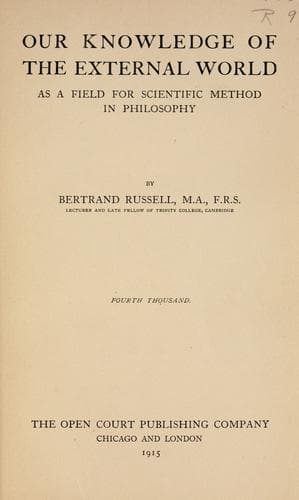
Our Knowledge of the External World as a Field for Scientific Method in PhilosophyRussell, Bertrand
Philosophy
Our Knowledge of the External World as a Field for Scientific Method in Philosophy
Russell, Bertrand
Knowledge, Theory of; Logical atomism
[44] Aristotle's words are: "The second is the so-called Achilles. It
consists in this, that the slower will never be overtaken in its
course by the quickest, for the pursuer must always come first to the
point from which the pursued has just departed, so that the slower
must necessarily be always still more or less in advance." _Phys._,
vi. 9. 239B (R.P. 137).
This argument is essentially the same as the previous one. It shows
that, if Achilles ever overtakes the tortoise, it must be after an
infinite number of instants have elapsed since he started. This is in
fact true; but the view that an infinite number of instants make up an
infinitely long time is not true, and therefore the conclusion that
Achilles will never overtake the tortoise does not follow.
The third argument,[45] that of the arrow, is very interesting. The text
has been questioned. Burnet accepts the alterations of Zeller, and
paraphrases thus:
"The arrow in flight is at rest. For, if everything is at rest when it
occupies a space equal to itself, and what is in flight at any given
moment always occupies a space equal to itself, it cannot move."
[45] _Phys._, vi. 9. 239B (R.P. 138).
But according to Prantl, the literal translation of the unemended text
of Aristotle's statement of the argument is as follows: "If everything,
when it is behaving in a uniform manner, is continually either moving or
at rest, but what is moving is always in the _now_, then the moving
arrow is motionless." This form of the argument brings out its force
more clearly than Burnet's paraphrase.
Here, if not in the first two arguments, the view that a finite part of
time consists of a finite series of successive instants seems to be
assumed; at any rate the plausibility of the argument seems to depend
upon supposing that there are consecutive instants. Throughout an
instant, it is said, a moving body is where it is: it cannot move during
the instant, for that would require that the instant should have parts.
Thus, suppose we consider a period consisting of a thousand instants,
and suppose the arrow is in flight throughout this period. At each of
the thousand instants, the arrow is where it is, though at the next
instant it is somewhere else. It is never moving, but in some miraculous
way the change of position has to occur _between_ the instants, that is
to say, not at any time whatever. This is what M. Bergson calls the
cinematographic representation of reality. The more the difficulty is
meditated, the more real it becomes. The solution lies in the theory of
continuous series: we find it hard to avoid supposing that, when the
arrow is in flight, there is a _next_ position occupied at the _next_
moment; but in fact there is no next position and no next moment, and
when once this is imaginatively realised, the difficulty is seen to
disappear.
The fourth and last of Zeno's arguments is[46] the argument of the
stadium.
[46] _Phys._, vi. 9. 239B (R.P. 139).
Public-domain text, read in full here on John Shaqi.
Reviews
Reviews
No reviews yet
Be the first to share your thoughts on this work.
Elsewhere in the archive
Join the Discussion
Join the discussion
Sign in to leave a comment or review.
Sign InorCreate an account