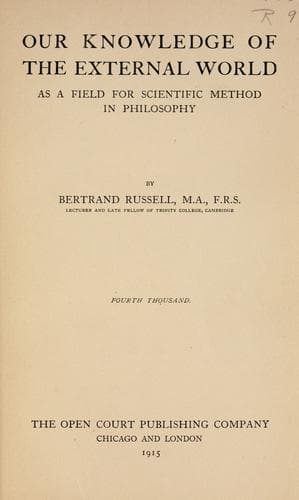
Our Knowledge of the External World as a Field for Scientific Method in PhilosophyRussell, Bertrand
Philosophy
Our Knowledge of the External World as a Field for Scientific Method in Philosophy
Russell, Bertrand
Knowledge, Theory of; Logical atomism
Of the prospect of progress in philosophy, it would be rash to speak
with confidence. Many of the traditional problems of philosophy, perhaps
most of those which have interested a wider circle than that of
technical students, do not appear to be soluble by scientific methods.
Just as astronomy lost much of its human interest when it ceased to be
astrology, so philosophy must lose in attractiveness as it grows less
prodigal of promises. But to the large and still growing body of men
engaged in the pursuit of science--men who hitherto, not without
justification, have turned aside from philosophy with a certain
contempt--the new method, successful already in such time-honoured
problems as number, infinity, continuity, space and time, should make an
appeal which the older methods have wholly failed to make. Physics, with
its principle of relativity and its revolutionary investigations into
the nature of matter, is feeling the need for that kind of novelty in
fundamental hypotheses which scientific philosophy aims at facilitating.
The one and only condition, I believe, which is necessary in order to
secure for philosophy in the near future an achievement surpassing all
that has hitherto been accomplished by philosophers, is the creation of
a school of men with scientific training and philosophical interests,
unhampered by the traditions of the past, and not misled by the literary
methods of those who copy the ancients in all except their merits.
INDEX
Absolute, 6, 39.
Abstraction, principle of, 42, 124 ff.
Achilles, Zeno's argument of, 173.
Acquaintance, 25, 144.
Activity, 224 ff.
Allman, 161 n.
Analysis, 185, 204, 211, 241.
legitimacy of, 150.
Anaximander, 3.
Antinomies, Kant's, 155 ff.
Aquinas, 10.
Aristotle, 40, 160 n., 161 ff., 240.
Arrow, Zeno's argument of, 173.
Assertion, 52.
Atomism, logical, 4.
Atomists, 160.
Belief, 58.
primitive and derivative, 69 ff.
Bergson, 4, 11, 13, 20 ff., 137, 138, 150, 158, 165, 174, 178, 229 ff.
Berkeley, 63, 64, 102.
Bolzano, 165.
Boole, 40.
Bradley, 6, 39, 165.
Broad, 172 n.
Brochard, 169 n.
Burnet, 19 n., 160 n., 161 n., 170 n., 171 ff.
Calderon, 95.
Cantor, vi, vii, 155, 165, 190, 194, 199.
Categories, 38.
Causal laws, 109, 212 ff.
evidence for, 216 ff.
in psychology, 219.
Causation, 34 ff., 79, 212 ff.
law of, 221.
not _a priori_, 223, 232.
Cause, 220, 223.
Certainty, degrees of, 67, 68, 212.
Change,
demands analysis, 151.
Cinematograph, 148, 174.
Classes, 202.
non-existence of, 205 ff.
Classical tradition, 3 ff., 58.
Complexity, 145, 157 ff.
Compulsion, 229, 233 ff.
Congruence, 195.
Consecutiveness, 134.
Conservation, 105.
Constituents of facts, 51, 145.
Construction _v._ inference, iv.
Contemporaries, initial, 119, 120 n.
Continuity, 64, 129 ff., 141 ff., 155 ff.
of change, 106, 108, 130 ff.
Public-domain text, read in full here on John Shaqi.
Reviews
Reviews
No reviews yet
Be the first to share your thoughts on this work.
Elsewhere in the archive
Join the Discussion
Join the discussion
Sign in to leave a comment or review.
Sign InorCreate an account