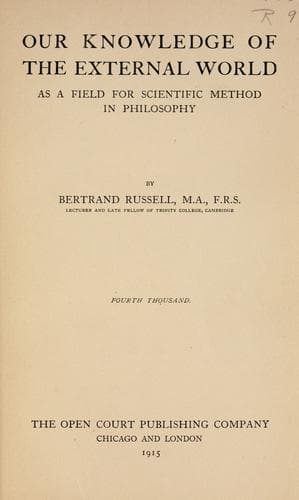
Our Knowledge of the External World as a Field for Scientific Method in PhilosophyRussell, Bertrand
Philosophy
Our Knowledge of the External World as a Field for Scientific Method in Philosophy
Russell, Bertrand
Knowledge, Theory of; Logical atomism
When we say that one thing is "independent" of another, we may mean
either that it is logically possible for the one to exist without the
other, or that there is no causal relation between the two such that the
one only occurs as the effect of the other. The only way, so far as I
know, in which one thing can be _logically_ dependent upon another is
when the other is _part_ of the one. The existence of a book, for
example, is logically dependent upon that of its pages: without the
pages there would be no book. Thus in this sense the question, "Can we
know of the existence of any reality which is independent of ourselves?"
reduces to the question, "Can we know of the existence of any reality of
which our Self is not part?" In this form, the question brings us back
to the problem of defining the Self; but I think, however the Self may
be defined, even when it is taken as the bare subject, it cannot be
supposed to be part of the immediate object of sense; thus in this form
of the question we must admit that we can know of the existence of
realities independent of ourselves.
The question of causal dependence is much more difficult. To know that
one kind of thing is causally independent of another, we must know that
it actually occurs without the other. Now it is fairly obvious that,
whatever legitimate meaning we give to the Self, our thoughts and
feelings are causally dependent upon ourselves, _i.e._ do not occur when
there is no Self for them to belong to. But in the case of objects of
sense this is not obvious; indeed, as we saw, the common-sense view is
that such objects persist in the absence of any percipient. If this is
the case, then they are causally independent of ourselves; if not, not.
Thus in this form the question reduces to the question whether we can
know that objects of sense, or any other objects not our own thoughts
and feelings, exist at times when we are not perceiving them. This form,
in which the difficult word "independent" no longer occurs, is the form
in which we stated the problem a minute ago.
Our question in the above form raises two distinct problems, which it is
important to keep separate. First, can we know that objects of sense, or
very similar objects, exist at times when we are not perceiving them?
Secondly, if this cannot be known, can we know that other objects,
inferable from objects of sense but not necessarily resembling them,
exist either when we are perceiving the objects of sense or at any other
time? This latter problem arises in philosophy as the problem of the
"thing in itself," and in science as the problem of matter as assumed in
physics. We will consider this latter problem first.
Public-domain text, read in full here on John Shaqi.
Reviews
Reviews
No reviews yet
Be the first to share your thoughts on this work.
Join the Discussion
Join the discussion
Sign in to leave a comment or review.
Sign InorCreate an account