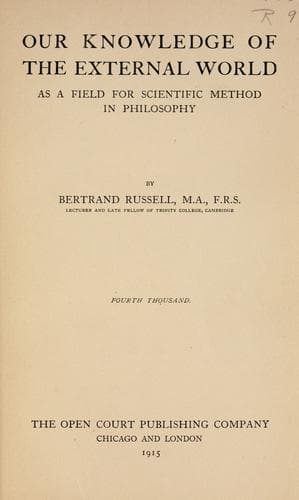
Our Knowledge of the External World as a Field for Scientific Method in PhilosophyRussell, Bertrand
Philosophy
Our Knowledge of the External World as a Field for Scientific Method in Philosophy
Russell, Bertrand
Knowledge, Theory of; Logical atomism
When we speak of the "external" world in this discussion, we must not
mean "spatially external," unless "space" is interpreted in a peculiar
and recondite manner. The immediate objects of sight, the coloured
surfaces which make up the visible world, are spatially external in the
natural meaning of this phrase. We feel them to be "there" as opposed to
"here"; without making any assumption of an existence other than hard
data, we can more or less estimate the distance of a coloured surface.
It seems probable that distances, provided they are not too great, are
actually given more or less roughly in sight; but whether this is the
case or not, ordinary distances can certainly be estimated approximately
by means of the data of sense alone. The immediately given world is
spatial, and is further not wholly contained within our own bodies. Thus
our knowledge of what is external in this sense is not open to doubt.
Another form in which the question is often put is: "Can we know of the
existence of any reality which is independent of ourselves?" This form
of the question suffers from the ambiguity of the two words
"independent" and "self." To take the Self first: the question as to
what is to be reckoned part of the Self and what is not, is a very
difficult one. Among many other things which we may mean by the Self,
two may be selected as specially important, namely, (1) the bare subject
which thinks and is aware of objects, (2) the whole assemblage of things
that would necessarily cease to exist if our lives came to an end. The
bare subject, if it exists at all, is an inference, and is not part of
the data; therefore this meaning of Self may be ignored in our present
inquiry. The second meaning is difficult to make precise, since we
hardly know what things depend upon our lives for their existence. And
in this form, the definition of Self introduces the word "depend," which
raises the same questions as are raised by the word "independent." Let
us therefore take up the word "independent," and return to the Self
later.
Public-domain text, read in full here on John Shaqi.
Reviews
Reviews
No reviews yet
Be the first to share your thoughts on this work.
Join the Discussion
Join the discussion
Sign in to leave a comment or review.
Sign InorCreate an account