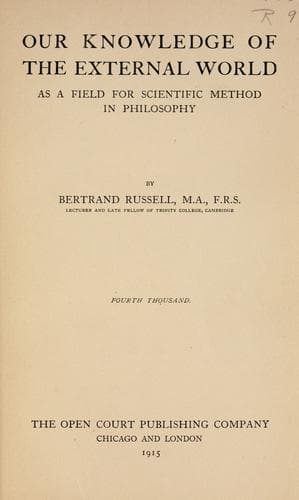
Our Knowledge of the External World as a Field for Scientific Method in PhilosophyRussell, Bertrand
Philosophy
Our Knowledge of the External World as a Field for Scientific Method in Philosophy
Russell, Bertrand
Knowledge, Theory of; Logical atomism
Accepting the indubitable momentary reality of objects of sense, the
next thing to notice is the confusion underlying objections derived from
their changeableness. As we walk round the table, its aspect changes;
but it is thought impossible to maintain either that the table changes,
or that its various aspects can all "really" exist in the same place. If
we press one eyeball, we shall see two tables; but it is thought
preposterous to maintain that there are "really" two tables. Such
arguments, however, seem to involve the assumption that there can be
something more real than objects of sense. If we see two tables, then
there _are_ two visual tables. It is perfectly true that, at the same
moment, we may discover by touch that there is only one tactile table.
This makes us declare the two visual tables an illusion, because usually
one visual object corresponds to one tactile object. But all that we are
warranted in saying is that, in this case, the manner of correlation of
touch and sight is unusual. Again, when the aspect of the table changes
as we walk round it, and we are told there cannot be so many different
aspects in the same place, the answer is simple: what does the critic of
the table mean by "the same place"? The use of such a phrase presupposes
that all our difficulties have been solved; as yet, we have no right to
speak of a "place" except with reference to one given set of momentary
sense-data. When all are changed by a bodily movement, no place remains
the same as it was. Thus the difficulty, if it exists, has at least not
been rightly stated.
We will now make a new start, adopting a different method. Instead of
inquiring what is the minimum of assumption by which we can explain the
world of sense, we will, in order to have a model hypothesis as a help
for the imagination, construct one possible (not necessary) explanation
of the facts. It may perhaps then be possible to pare away what is
superfluous in our hypothesis, leaving a residue which may be regarded
as the abstract answer to our problem.
Public-domain text, read in full here on John Shaqi.
Reviews
Reviews
No reviews yet
Be the first to share your thoughts on this work.
Elsewhere in the archive
Join the Discussion
Join the discussion
Sign in to leave a comment or review.
Sign InorCreate an account