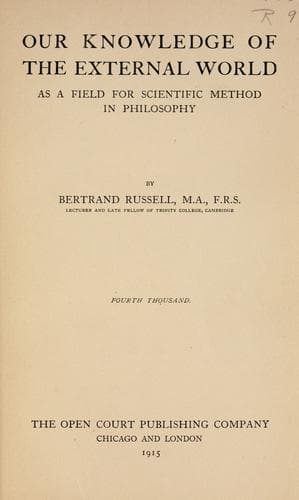
Our Knowledge of the External World as a Field for Scientific Method in PhilosophyRussell, Bertrand
Philosophy
Our Knowledge of the External World as a Field for Scientific Method in Philosophy
Russell, Bertrand
Knowledge, Theory of; Logical atomism
Two men are sometimes found to perceive very similar perspectives, so
similar that they can use the same words to describe them. They say they
see the same table, because the differences between the two tables they
see are slight and not practically important. Thus it is possible,
sometimes, to establish a correlation by similarity between a great many
of the things of one perspective, and a great many of the things of
another. In case the similarity is very great, we say the points of view
of the two perspectives are near together in space; but this space in
which they are near together is totally different from the spaces inside
the two perspectives. It is a relation between the perspectives, and is
not in either of them; no one can perceive it, and if it is to be known
it can be only by inference. Between two perceived perspectives which
are similar, we can imagine a whole series of other perspectives, some
at least unperceived, and such that between any two, however similar,
there are others still more similar. In this way the space which
consists of relations between perspectives can be rendered continuous,
and (if we choose) three-dimensional.
We can now define the momentary common-sense "thing," as opposed to its
momentary appearances. By the similarity of neighbouring perspectives,
many objects in the one can be correlated with objects in the other,
namely, with the similar objects. Given an object in one perspective,
form the system of all the objects correlated with it in all the
perspectives; that system may be identified with the momentary
common-sense "thing." Thus an aspect of a "thing" is a member of the
system of aspects which _is_ the "thing" at that moment. (The
correlation of the times of different perspectives raises certain
complications, of the kind considered in the theory of relativity; but
we may ignore these at present.) All the aspects of a thing are real,
whereas the thing is a mere logical construction. It has, however, the
merit of being neutral as between different points of view, and of being
visible to more than one person, in the only sense in which it can ever
be visible, namely, in the sense that each sees one of its aspects.
It will be observed that, while each perspective contains its own space,
there is only one space in which the perspectives themselves are the
elements. There are as many private spaces as there are perspectives;
there are therefore at least as many as there are percipients, and there
may be any number of others which have a merely material existence and
are not seen by anyone. But there is only one perspective-space, whose
elements are single perspectives, each with its own private space. We
have now to explain how the private space of a single perspective is
correlated with part of the one all-embracing perspective space.
Public-domain text, read in full here on John Shaqi.
Reviews
Reviews
No reviews yet
Be the first to share your thoughts on this work.
Elsewhere in the archive
Join the Discussion
Join the discussion
Sign in to leave a comment or review.
Sign InorCreate an account