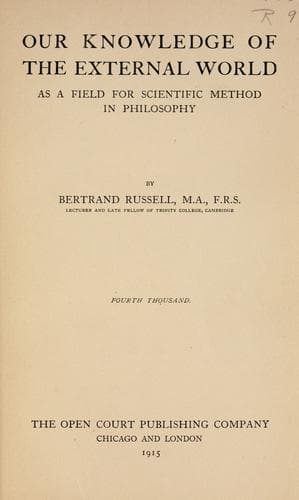
Our Knowledge of the External World as a Field for Scientific Method in PhilosophyRussell, Bertrand
Philosophy
Our Knowledge of the External World as a Field for Scientific Method in Philosophy
Russell, Bertrand
Knowledge, Theory of; Logical atomism
We shall say that an event is "at" an instant when it is a member of the
group by which the instant is constituted; and we shall say that one
instant is before another if the group which is the one instant contains
an event which is earlier than, but not simultaneous with, some event in
the group which is the other instant. When one event is earlier than,
but not simultaneous with another, we shall say that it "wholly
precedes" the other. Now we know that of two events which are not
simultaneous, there must be one which wholly precedes the other, and in
that case the other cannot also wholly precede the one; we also know
that, if one event wholly precedes another, and the other wholly
precedes a third, then the first wholly precedes the third. From these
facts it is easy to deduce that the instants as we have defined them
form a series.
We have next to show that every event is "at" at least one instant,
_i.e._ that, given any event, there is at least one class, such as we
used in defining instants, of which it is a member. For this purpose,
consider all the events which are simultaneous with a given event, and
do not begin later, _i.e._ are not wholly after anything simultaneous
with it. We will call these the "initial contemporaries" of the given
event. It will be found that this class of events is the first instant
at which the given event exists, provided every event wholly after some
contemporary of the given event is wholly after some _initial_
contemporary of it.
Finally, the series of instants will be compact if, given any two events
of which one wholly precedes the other, there are events wholly after
the one and simultaneous with something wholly before the other. Whether
this is the case or not, is an empirical question; but if it is not,
there is no reason to expect the time-series to be compact.[17]
[17] The assumptions made concerning time-relations in the above are
as follows:--
I. In order to secure that instants form a series, we assume:
(a) No event wholly precedes itself. (An "event" is defined as
whatever is simultaneous with something or other.)
(b) If one event wholly precedes another, and the other wholly
precedes a third, then the first wholly precedes the third.
(c) If one event wholly precedes another, it is not simultaneous
with it.
(d) Of two events which are not simultaneous, one must wholly
precede the other.
II. In order to secure that the initial contemporaries of a given
event should form an instant, we assume:
(e) An event wholly after some contemporary of a given event is
wholly after some _initial_ contemporary of the given event.
III. In order to secure that the series of instants shall be
compact, we assume:
(f) If one event wholly precedes another, there is an event wholly
after the one and simultaneous with something wholly before the
other.
Public-domain text, read in full here on John Shaqi.
Reviews
Reviews
No reviews yet
Be the first to share your thoughts on this work.
Elsewhere in the archive
Join the Discussion
Join the discussion
Sign in to leave a comment or review.
Sign InorCreate an account