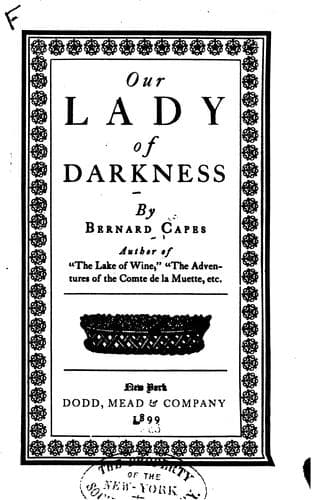
British -- France -- Fiction; France -- History -- Revolution, 1789-1799 -- Fiction; Historical fiction
“Have I a constitutional frost in my blood, as my uncle believes? Is
my every relation with my fellows to be for ever unimpulsive and
coldly analytical? That should lead me at least to a nice selection in
pairing-time: and to what else?--a career stately, sober, colourless;
a faultless reputation; all the virtues ranked upon my tombstone
by-and-by for gaping cits to spell over, and perhaps, if I am very
good, for a verger to expound. And my widow that is to be--my fair
decent relict that shall have never known me condescend to a weakness
or perpetrate an injustice, that shall never have felt the frost melt
in her arms!”
He jumped suddenly to his feet, his teeth--very even and white
ones--showing in a queer little smile. He stretched; he took off his
rather battered hat and passed a hand through the crisp umber stubble
of his hair. His solemn eyes shone out as blue as lazulite from the
sun-burn of his face. He seemed, indeed, from his appearance no
fitting catechumen in a religion of everlasting continence. There must
be underwarmth somewhere for the surface so to flower into colour.
“She would marry within six months of my death,” he cried; “probably a
libertine who would dissipate her estates, and break her heart, and
die, and be mourned by her long after my memory was drier than a pinch
of dust to all who had known me.”
He laughed again on a note that sighed a little in the fall.
“Am I like that? Do I build all this time with dry dust for mortar? Am
I a loveless anchorite because my sympathies will not answer to the
coarseness of an appeal that my taste rejects? Is it quite human to be
very fastidious in so warm a respect? Or do I only wait the instant of
divine inspiration to recognise that other self that seems hidden from
me by an impenetrable veil?”
He shook his head despondently, collected his traps, and went on his
way to Liége.
There he remained no longer than was necessary to a settlement in the
matter of certain bills of credit and to the chartering of a vehicle
for his onward stages. He was to return to the coast by way of Namur,
Lille, and Calais. For the time he was all out of humour with a
nomadic philosophy, and desired only to reach England by as short a
route as possible.
He set sail in the Fanny Crowther packet, and had a taste of Channel
weather that was as good as a “constitutional” after a debauch. He was
two days at sea, beating forth and back at the caprice of squabbling
winds; and when at last he landed in Dover it was with the drenched
whitewashed feeling of a convalescent from fever.
Public-domain text, read in full here on John Shaqi.
Reviews
Reviews
No reviews yet
Be the first to share your thoughts on this work.
Elsewhere in the archive
Join the Discussion
Join the discussion
Sign in to leave a comment or review.
Sign InorCreate an account