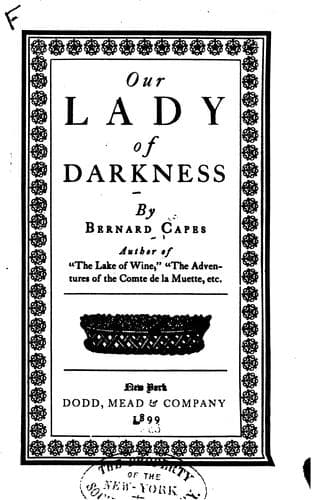
British -- France -- Fiction; France -- History -- Revolution, 1789-1799 -- Fiction; Historical fiction
She gave a little staccato shriek of mockery, and attacked him without
hesitation. The monkey still perched on her shoulder. With her third
pass, Ned felt that his life was in the hands of a consummate
_tireuse_; her fourth took him clean through the fleshy part of the
right shoulder.
Madame withdrew and lowered the red lance, that dropped a little
crimson on the carpet, like an overcharged pen. The tipsy old lord had
scrambled to his feet. His inflamed eyes seemed to gutter like
expiring dips. He yelled out oaths and blasphemy.
“Kill him!” he shrieked: “I hate him--do you hear! kill him!”
Ned, reeling a little, and clutching at a chair-back, dimly wondered
if this were indeed but a villainous plot to rid his kinsman of a
detested incubus. He felt powerless and sick, but madame’s voice
reassured him.
“Bah!” she cried gruffly, “you are very tipsy indeed. Hold your
tongue, and drink some more wine!”
He was conscious, then, of her near neighbourhood; of the fact that
she was binding up his arm.
“It is leetle--but enough,” he heard her mutter.
Then she looked over to where my lord sat glowering and collapsed.
“A coach, if you please!” she said peremptorily. “It must not arrive
that he pass the night heere in your house.”
The uncle laughed inanely.
“What!” he said, “d’ye think I should finish him and put the blame
on--on another? Take him to the devil, if you will.”
“No,” said she, “but I weel convey’a heem to his lodgings out of the
devil’s way.”
CHAPTER XIX.
Of so wanton and inexplicable a nature had been the assault
committed on him, that for some three days succeeding it Ned could
have fancied himself lying rather in a stupor of amazement than in the
semi-consciousness engendered of a certain degree of pain and fever.
His _contretemps_ with his uncle; the latter’s more than usually
uncompromising attitude of offence towards him; most of all, the
strange vision of madame, with her obvious intention to insult and
disable him,--all this in the retrospect inclined him to consider
himself the late victim of a delirium that was reflex to the hideous
pictures painted in Paris upon his brain.
But, on the fourth morning of his retirement, finding himself awake to
the humour of the situation, he knew that his distemper was
retreating, and that he might claim himself for a convalescent.
“Astonishment is a good febrifuge,” he thought. “How long have I lain
in it, as in a cooling bath?”
And it is indeed strange how blessed an exorcist of pain is absorbing
wonder. Not knowledge of drugs for the body but of drugs for the mind
shall some day perhaps redeem the world from suffering: the Theatre of
Variety, not of the hospital, be the Avalon of the maimed and the
smitten.
He had no memory as to who--if anybody--had visited him during the
course of his fever.
“But, no doubt,” he thought, “this moderate blood-letting has very
timely rectified a bad effusion to my brain, and madame is my
unconscious physician.”
Public-domain text, read in full here on John Shaqi.
Reviews
Reviews
No reviews yet
Be the first to share your thoughts on this work.
Elsewhere in the archive
Join the Discussion
Join the discussion
Sign in to leave a comment or review.
Sign InorCreate an account