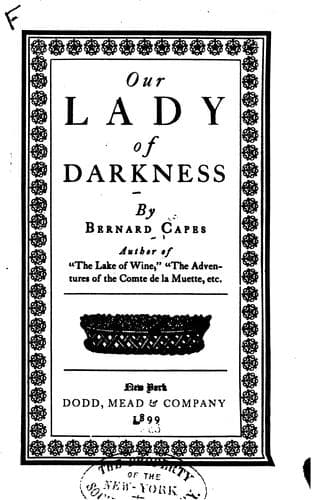
British -- France -- Fiction; France -- History -- Revolution, 1789-1799 -- Fiction; Historical fiction
“Servant, sir,” said he.
“Oh, all right,” said Ned.
“You’ll be a-dry, belike?” said the man.
“What’s that?”
“Drythe, you’ll call it, for a glass of hale.”
“Certainly not,” answered the convalescent snappishly.
“’Tis a very good substitoot for the stomach,” said the man, and
vanished.
“Hi!” shrieked Ned again.
The face reappeared.
“Why don’t you bring your harp and play up here, confound you!”
The eyes opened and withdrew like phantasmagoria. Presently the man
was to be heard stumbling upstairs with a burden--in fact, he brought
in his instrument and seated himself at it.
“Play?” said he; and Ned nodded.
And now the young gentleman was to read in that book of revelations
that treats of the incongruous partiality of divinity in its giving
moods. The man beside him was, to appearance, a dull enough fellow, a
plodding, leather-palmed, labouring man of smoky intelligence. Yet,
for all their horny cuticle, his fingers seemed to burn as luminous as
those of the Troll in the fairy tale. They spouted music; the fire of
inspiration ran out of their tips along the strings till the ceiling
of the common little room vibrated deliciously as the dome of an elfin
bell. And he extemporised, it would appear; he wove a web of chords
about himself as it were a cocoon, out of which he should one day
burst and be acknowledged glorious.
“Surely,” thought Ned, “if it isn’t necessary to be a fool to be a
musician, at least the majority of born musicians are fools.”
That was his opinion, and he held it in common with a good many
people. The musical, more than any other form of temperament, would
appear to be self-sufficient. Its stream may flow and harp, like an
Iceland river, through a woefully barren country.
The heavy man played on and on, enraptured, exalted, till his wife
came home from church. Then she flew like an angry bee to the sweet
twang of his instrument, and opened on him wide-eyed and -mouthed.
“Saving your honour’s presence----” she began.
“Or my life,” said Ned. “He hath built me up my constitution as
Amphion built the walls of Thebes. I asked him to come and play, and
he hath finished me my cure.”
“Well, now, fegs!” said the woman dubiously. “And they call him
pethery John,” said she. “’Tis his fancy to confide himself to his
harp once in the week. The stroke of his chisel, the taste of his
bacon, the cry of the sea--every thought and act of the six days will
he work into them wires on the seventh. An honest, sober man, sir,
weren’t ’t for his Sabbath folly.”
“And what is his business?” asked Ned, for the husband had shouldered
his harp and disappeared.
“A stonemason’s,” she answered; “and none to come anigh him.”
She added with pride, “He’s a foreman at the excavating over to the
cliffs yonder.”
“Oh!” said Ned. “And what are they excavating for?”
“Lord save your honour!” she cried, “don’t ye know as we’re
a-fortifying against the coming of they bloody French?”
“No,” said Ned.
“Well,” she answered, “we be.”
Public-domain text, read in full here on John Shaqi.
Reviews
Reviews
No reviews yet
Be the first to share your thoughts on this work.
Elsewhere in the archive
Join the Discussion
Join the discussion
Sign in to leave a comment or review.
Sign InorCreate an account