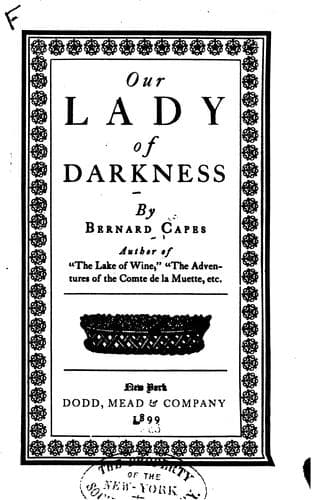
British -- France -- Fiction; France -- History -- Revolution, 1789-1799 -- Fiction; Historical fiction
Ned set foot on the long box-bordered path with his mind in a
condition of strange ferment. The glamour of the previous night; the
sweet glory of this new bidding to the side of his mistress (over
which his soul laughed, as over its own humorous strategy in the
hoodwinking of a credulous guardian); the thought that it was in his
power to assist to its welfare the very dear object of his solicitude,
and, by so assisting, to convert what might otherwise seem a pursuit
into a welcome--such fancies combined made of his brain a house of
pleasant dreams. All down the bed-rows the scent of blossoming
mignonette accompanied him to the arbour at the end of the garden. To
his dying day this gentle green flower remained the asphodel of his
heaven. Great ships of cloud, carrying freightage of hidden stars,
sailed slowly across the sky to ports beyond the vision of the world.
Yet there did not seem enough wind to discrown a thistle-head. The
lark rose straight as the smoke from the town chimneys, dropping a
clew of song into the very gaping throats of his own nestlings in the
field. The rattle of a horse’s headstall, the drowsy thunder of
rolling skittle-balls, came over the wall from the neighbouring inn as
distinct in their every vibration as though the silence of night, in a
motionless atmosphere, had merged itself imperceptibly in the life of
a day but half awake. And, behold! at the end of the garden was the
crystallised expression of all this peace and beauty, the breathing
spirit of the roses and of the mignonette. Ned, as he looked down upon
her, had a thought that, if she woke, the wind would rise, the
rose-leaves scatter, and the cloud argosies dash themselves shapeless
on rocks of air.
How pretty she was! Great God, how pretty and how innocent! To him who
had fronted stubbornly the storms of passion, who had been sought a
sacrifice to the misconsecrated heats of a love whose name in
consequence he had learned to loathe, this new power of reverence was
most wonderful and most dear. He could have worshipped, had he not
loved so humanly.
Mademoiselle was sunk a little back into the leafage of the arbour.
Her eyes were closed, her lips a trifle parted. She was cuddled into a
pink _négligé_. Everything she wore seemed to caress her. An open
book lay upon her lap, one slender finger serving for listless marker
in it.
Suddenly a tiny smile, the ghostliest throb of laughter, flickered at
the corners of her mouth. Ned leapt hot all over.
“Oh, monsieur!” murmured the unconscionable witch, as if talking in
her sleep, “but are you the doctor?”
“Yes,” said Ned.
She put out a languid hand, never raising her eyelids.
“Madame-maman says it is the cake; but I think it is the Englishman
that lies heavy on me.”
“What Englishman?” said Ned.
“My lord the Englishman, monsieur. Is he not the heaviest of all in
Bury?”
Ned touched the young healthy pulse as if he handled a wax flower.
“If that is the trouble,” said he, “it is soon dealt with.”
Public-domain text, read in full here on John Shaqi.
Reviews
Reviews
No reviews yet
Be the first to share your thoughts on this work.
Elsewhere in the archive
Join the Discussion
Join the discussion
Sign in to leave a comment or review.
Sign InorCreate an account