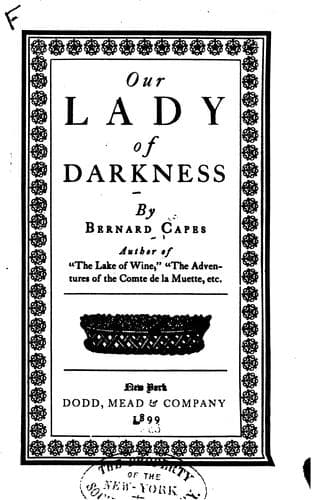
British -- France -- Fiction; France -- History -- Revolution, 1789-1799 -- Fiction; Historical fiction
“Here? Brussels, do you mean? He has not, to my knowledge, been in
Brussels these six months--no, not since January, when he came to meet
the demoiselle Théroigne on her return from the Austrian prisons, and
conducted her back to the capital.”
“Théroigne!” exclaimed Ned in faint amazement.
“So she is called, I believe,” went on the placid creature, oblivious
of the little emotion she had caused. “Monsieur has heard of her, no
doubt. She is beautiful, and of easy virtue, they say. At her house in
the Rue de Rohan the most violent propagandists assemble nightly to
discuss the overthrow of the present social conditions. I wish they
would leave them alone: they are very reasonable, I think--to all at
least who have assured incomes. She is quite a force in Paris, this
woman. They sent her some time last year _en mission_ to these
Netherlands to preach the new religion. But she was arrested by the
agents of the Emperor and conveyed to Vienna, whence she was dismissed
no later than last January. Monseigneur was hunting with M. de
Lawoestine at the time, and he heard somehow, and came straight on to
Brussels, and carried the demoiselle Théroigne away.”
“And that was the last you have seen of him? Yet your mother had no
doubt but that he was in this neighbourhood.”
“Oh, maman?” cried madame, with a tiny shrug of her shoulders. “But
she is as full of fancies as this mushroom is of grubs.”
“Indeed,” said Ned, quite dumfoundered, “I think you must be
misinformed as to monsieur le duc.”
“Very well,” she said indifferently. “It is possible, of course. M. de
Lawoestine is not communicative, nor am I curious. There is no reason
why they should not be in Liége together at this very moment.”
There was every reason, however, against such a meeting; but madame
had not the shadow of a diplomatic acumen.
“I must follow your husband to Liége, then,” said Ned.
“You will at least lie here for the night, monsieur?”
“A thousand pardons, madame. My business is of the most pressing; and
you yourself confess an ignorance as to the movements of monsieur le
comte.”
“_Mon Dieu_! I never trouble my head about them.”
“With madame’s permission I will bid her adieu at the end of the
meal.”
“As you will, monsieur. And if you do not find monsieur le duc in
Liége?”
“Then I shall go on to Paris.”
“I hope, then, monsieur’s passports are in order?”
“They take me into France by way of the Low Countries. Madame, your
mother, is responsible for them.”
“She is at any rate a woman of business. Nevertheless, the borders are
disturbed. I wish monsieur a very fair journey. I trust he will not be
struck by the lightning; but--Mother of Christ! I think there is a
storm coming such as we have never seen. I shall take some peaches and
some cake, and sit in the cellars till it is over.”
* * * * * * * *
Public-domain text, read in full here on John Shaqi.
Reviews
Reviews
No reviews yet
Be the first to share your thoughts on this work.
Elsewhere in the archive
Join the Discussion
Join the discussion
Sign in to leave a comment or review.
Sign InorCreate an account