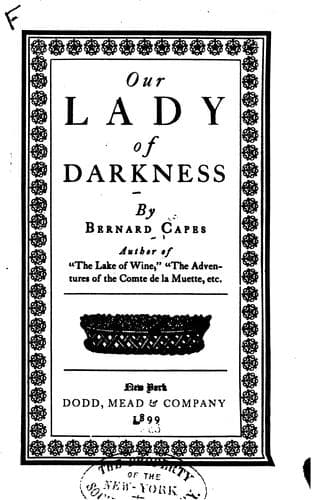
British -- France -- Fiction; France -- History -- Revolution, 1789-1799 -- Fiction; Historical fiction
He had actually cut his way a half-dozen yards before a hand--the
woman’s--seized him from the back and dragged him to the ground. With
a groan he fell, trampled into a forest of tattered legs.
“Cry to me for mercy!” screamed the harlot.
“No,” he answered faintly.
She yelled then, beating a space about her with her hands. “Lucien, it
is the moment that has come!”
Snarling and dribbling, a hideous thing broke through the press and
flung itself upon the fallen man.
* * * * * * * *
Torn and breathless, Ned shouldered his way at last into the little
bloody arena. A woman--her foot upon the neck of something, some
bespattered creature that whimpered and prayed to her--looked stupidly
down upon the dead and mangled body of the man she had destroyed.
“Accursed! oh, thou accursed!” panted the new-comer in terrible
emotion. “It is not he, St Denys, that thou hast murdered.”
CHAPTER XII.
From the day of the massacre in the Cour des Feuillans, when--a
casual and involuntary witness of the opening deed of blood--he had
made a desperate attempt to save the life of the man who, as he
supposed, was being sacrificed to a misconception, Ned had no thought
but that he was fallen, a second time and inextricably, under the
deadly spell of the city that was at once his horror and his
attraction. That he had not paid the penalty with his own life of so
quixotic an interposition rather confirmed him in the sense of
fatality that had overtaken him. He could afterwards only recall
vaguely the expression of terror with which Théroigne had accepted
his furious impeachment of her barbarity; the resentful rage of the
mob over his denunciation of its idol; his imminent peril, and the
immunity from personal harm suddenly and unexpectedly secured him at
the hands of the very loathed object of his execration. He had given
her no thanks for her advocacy. It had condemned him merely to
prolonged struggle with an existence that had grown hateful to him.
Defrauded of his love, disenchanted with life, his residue of the
latter was not, he felt, worth the devil’s purchase.
And yet this sentiment carried with it a certain wild passion of
personal irresponsibility that was not without its charm. Into the
being of the people that had waived for the present, it seemed, all
thought of consistent conduct, he was absorbed without effort of his
own--absorbed so helplessly, that even the wounding stab of a certain
question, once engrossingly poignant to himself, dulled of its pain
and could be borne. It was as difficult to think collectedly, indeed,
in the Paris of those days as it is while rushing through a strong
wind.
Public-domain text, read in full here on John Shaqi.
Reviews
Reviews
No reviews yet
Be the first to share your thoughts on this work.
Elsewhere in the archive
Join the Discussion
Join the discussion
Sign in to leave a comment or review.
Sign InorCreate an account