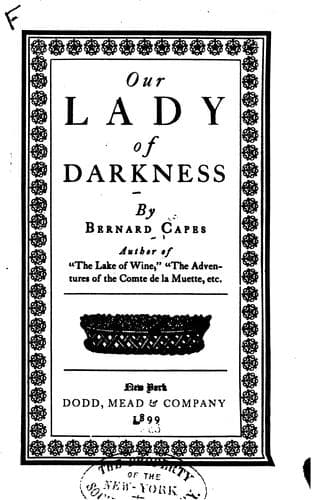
British -- France -- Fiction; France -- History -- Revolution, 1789-1799 -- Fiction; Historical fiction
Into the street she fled, ran a few paces, stopped, and looked wildly
about her. Snow had begun to fall. The wind whipped her thin tattered
skirts about her ankles. In all the mad night there was no beacon
towards which she might make, for the little lightening of her
despair. She glanced once about her; then crouched, with a dying moan,
upon a doorstep.
Her face was buried in her hands when, an instant later, Ned silently
came upon her. He stood, looking down.
Once, earlier in the evening, he had thought “She” (not the wretched
girl at his feet) “might have dismissed me as effectually by gentler
methods.” Yet, had he, for his part, shown more compassion towards
this unhappy outcast--stained though she was--who lay here so
committed to his mercy?
He bent suddenly, and put his hand upon her shoulder. She did not even
start now, but she uncoiled herself, with a shiver, and gazed up at
him, without recognition, it seemed.
“What do you intend to do?” he said. “Where will you go?”
She only shook her head weakly and amazedly.
He stepped back, looked up into a blinding gloom of darkness and
spinning flakes. The patterns these wrought seemed the very moral of
Heaven’s enactments--hieroglyphics drawn upon a slate of night. He was
not theologian enough to interpret them. For him--with a sense of
being enclosed and shut down within a very confined vault of human
suffering (with God, maybe, walking serene and unwitting high up on
the sunny lifts of ether above the earth)--the issues of life were
become brutally restricted. He had had aspirations. They had been
crushed under by the heavy night that had dropped upon his world. Now,
in a moment, he could feel only that he was alone with a woman who
loved him without one thought of the meaning of the hieroglyphics;
that it lay with him, unsupported, to direct the destinies of two
souls--his own and another’s--that Fortune had isolated in tragic
companionship.
And contrasted with the human piteousness of this other--this soul
that had claimed him in the darkness into which his own had
fallen--how did not the shibboleth of convention suddenly confess
itself a ridiculous fetish of strings and patches--a block for a
fashion-plate?
He had no plan of conduct at last but to drift--and, if by way of
sunny pastures, so much the less troubled would he be.
His heart was moved to a dull aching passion in this first realising
of its emancipation from a wounding thrall.
“Get up!” he cried violently. “Do you hear? Get up, and come with me!”
He turned away, and going a few paces, looked round to see if she were
following. Ay, like a dog. She had risen and jumped to his order
before it was well issued.
Public-domain text, read in full here on John Shaqi.
Reviews
Reviews
No reviews yet
Be the first to share your thoughts on this work.
Elsewhere in the archive
Join the Discussion
Join the discussion
Sign in to leave a comment or review.
Sign InorCreate an account