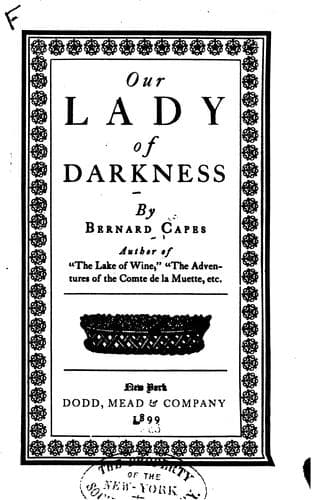
British -- France -- Fiction; France -- History -- Revolution, 1789-1799 -- Fiction; Historical fiction
“Very well,” he said, “but I saddle the agreement with one fixed
condition. As long as you remain here--whether it is for one day, or
two, or more--you are to hold no communication with me--are never to
speak to me, unless I first address you.”
She rose to her knees, clasping her hands again to him. Her hair was
fallen over her cheeks; she looked a very small forlorn subject for
extreme measures.
“I shall be near you,” she said, half-choking.
He took her arm and motioned her to her feet.
“It is understood, then. You had better go to bed now and rest and
recover and get warm.”
He put a candle into her hand, led her to the door of the bedroom,
thrust her gently within, and clicked the latch upon her. Then he went
and stood over the fire.
What had he done? What was he doing? Even as he had spoken, making his
condition, he had known that that was a wild absurdity, impossible of
fulfilment. What had moved him to it but a sudden recrudescence of
that self-mutilating spirit? He had had no deliberate thought to goad
a willing jade, or to return, in kind, to love, the humiliation he had
suffered from it. Yet he knew that he was doing so, and it was a
perilous lust to indulge.
His heart was full of ache, his brain of phantoms. These were
reflected, coming and going, in the still red logs of the fire. They
represented, in a thousand aspects, the three ghosts that would haunt
his life for evermore. All women--all fair and fateful shapes; and, of
the three, the vilest, because she had figured for the purest, was the
one that had come to claim him at the last. It was a fierce satire
upon the lesson of ennobling ideals.
Pamela, and Théroigne, and Nicette. He felt it no sacrilege now to
name this trinity in a breath. Indeed, which alone of the three had
made it her sport to coquet with hearts, holding their suffering as
nothing to the gratification of her vanity? Not either of those
peasant girls of Méricourt--whose passionate blood would always
rather flame to the ecstasy of pursuit than to the selfish rapture of
being hunted for the sake of their own beautiful skins.
His thoughts swerved from one figure to another. This Lord Edward
Fitzgerald--how had he come to usurp the very throne of desire? He
knew a little of him by repute--had heard of the ardent young soldier
and apostle of the new liberty, melancholy and something wild,
breathing the spirit of romance. He had no grudge against him, at
least. And what of Mr Sheridan, whose influence alone he had
apprehended? Ghosts they were to him now. What profit was it to seek
to analyse their bodiless significance?
Sweeping and shadowy, the smoke of all such phantoms reeled up the
chimney. Only one face remained with him.
He glanced at the bedroom door, lay down on the rug before the fire,
and, wrapping his cloak about his haggard face, committed himself to
the hopelessness of slumber.
CHAPTER XVI.
Public-domain text, read in full here on John Shaqi.
Reviews
Reviews
No reviews yet
Be the first to share your thoughts on this work.
Elsewhere in the archive
Join the Discussion
Join the discussion
Sign in to leave a comment or review.
Sign InorCreate an account