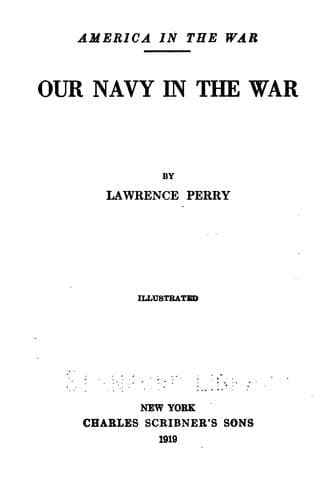
United States. Navy; World War, 1914-1918 -- Naval operations
The United States Navy appears to have figured chiefly through its
destroyer fleet. It has been stated that half the number of sailors who
were in the navy when we entered the war were sent to European waters.
The system of training them involves a number of training-bases in
Europe constantly filling up from American drafts. Each new destroyer
that steams to Europe from our shores in due course sends back some of
her men to form a nucleus for the crew of another new destroyer turning
up in American waters. Their places are taken by drafts from the
training-bases in Europe. The destroyer referred to as turning up in
this country makes up her complement from the battleships and other
naval units here. The training-bases in this country are established at
Newport, Chicago, San Francisco, and Pelham Bay, N.Y. Here the men have
many months' instruction. As their training approaches completion they
are sent where needed, and thus the work of creating an immense army of
trained seamen qualified for any sort of a task proceeds with mechanical
precision.
Submarine hunting is very popular with our young jackies, and great is
their satisfaction when some submarine falls victim to their vigilance,
their courage, and their unerring eyes.
"But," said a young sea officer not long ago, "the submarine is a
difficult bird to catch. He holds the advantage over the surface craft.
He always sees you first. Even when he is on the surface he is nearly
awash, and when submerged only his periscope appears above the water.
The submarine is not after animals of our breed--destroyers--and when he
can he avoids them. We may go several weeks without putting an eye upon
a single U-boat. When we do there is action, I can tell you. We start
for him at full speed, opening up with all our guns in the hope of
getting in a shot before he is able to submerge. But you may believe he
doesn't take long to get below the surface. Anyway, the sub doesn't mind
gun-fire much. They are afraid of depth charges--bombs which are
regulated so that they will explode at any depth we wish. They contain
two or three hundred pounds of high explosive, and all patrol vessels
and destroyers carry them on deck and astern. When we see a submarine
submerge we try to find his wake. Finding it, we run over it and drop a
bomb. The explosion can be felt under water for a distance of several
miles, but we have to get within ninety feet of the hull to damage it.
This damage may or may not cause the undersea boat to sink. Inside of
ninety feet, though, there isn't much doubt about the sinking.
Public-domain text, read in full here on John Shaqi.
Reviews
Reviews
No reviews yet
Be the first to share your thoughts on this work.
Join the Discussion
Join the discussion
Sign in to leave a comment or review.
Sign InorCreate an account