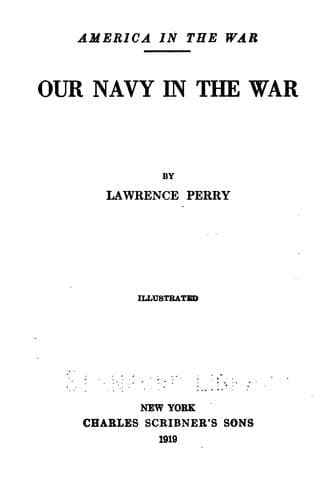
United States. Navy; World War, 1914-1918 -- Naval operations
"Patrol duty is a grind. The sea where we work is filled with wreckage
for a distance of 300 miles off shore, and you can take almost any
floating object for a periscope. Yes, we shoot at everything; ours is
not a business in which to take chances. Convoy work is more interesting
and more exciting than the round of patrol. The advantage of the convoy
over the picking up and escorting of a merchantman by a patrol-boat is
that in the convoy from six to ten destroyers can protect from ten to
thirty merchantmen, while under the patrol system one destroyer watches
one merchant craft. Convoy trips take our destroyers away from their
base from six to eight days, and they are all trying days, especially so
in dirty weather. On convoy duty no officer, and no man, has his clothes
off from start to finish. Too many things may happen to warrant any sort
of unpreparedness. Constant readiness is the watch-word.
"At night difficulty and danger increase, chiefly because of the
increased danger of collision. Collisions sometimes occur--what with the
absence of lights, the zigzag course of the ships of the convoy, and the
speed with which we travel. But as a rule the accidents are of the
scraping variety, and all thus is usually well. The convoy is purely a
defensive measure. The patrol is the offensive; in this the destroyers
and other craft go out and look for the U-boats, the idea being to hound
them out of the seas."
Then there are netting operations in which our sailors have played some
part. The netting most often used is made of stout galvanized wire with
a 15-foot mesh. This is cut into lengths of 170 feet, with a depth of 45
feet. On top of this great net are lashed immense blocks of wood for
buoys. Two oil-burning destroyers take the netting, and hanging it
between them as deep down in the water as it will go, are ready to seine
the 'silverfish.' The range of a submarine's periscope is little over a
mile in any sort of sea. Vessels that are belching clouds of smoke may
be picked up at distances of from three to five miles, but no more. In
other words, watchful eyes gazing through binoculars may see a periscope
as far as that periscope sees. The destroyers, bearing their net between
them, then pick up a distant periscope. They chart the submarine's
direction (this may be told by the direction in which the periscope is
cutting the water) and calculate her speed. Then they steam to a point
directly ahead of the submarine, and the lashings are cut away from the
net. While it thus floats in the submarine's path the destroyers speed
away out of eye-shot. In a large majority of cases it is claimed the
submarine runs into that net, or one like it. Results are a probable
disarrangement of her machinery and her balance upset. She may be thrown
over on her back. If she comes up she goes down again for good and all
with a hole shot in her hull; if not, it is just as well, a shell has
been saved.
Public-domain text, read in full here on John Shaqi.
Reviews
Reviews
No reviews yet
Be the first to share your thoughts on this work.
Join the Discussion
Join the discussion
Sign in to leave a comment or review.
Sign InorCreate an account