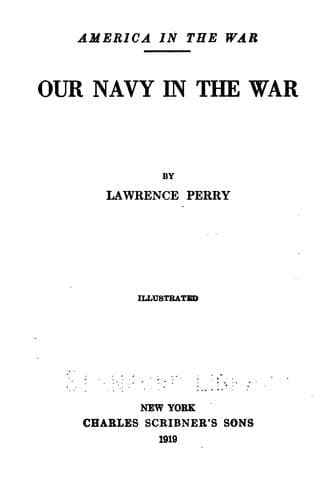
United States. Navy; World War, 1914-1918 -- Naval operations
Just how unpopular the service has been may be adduced from chance
remarks of German submarine prisoners who come to this country from time
to time. The men of the U-boat sunk by the _Fanning_ made no effort to
conceal their satisfaction at their change of quarters, while Germans in
other cases have told their British captors that they were glad they had
been taken.
There is the story of the storekeeper of the German submarine which sunk
several vessels off our coast last June. He said he had formerly served
on a German liner plying between Hoboken and Hamburg, and his great
regret was that he had not remained in this country when he had a
chance. Life on a submarine, he said, was a dog's life.
Even under peace conditions this is so. The men are cramped for room, in
the first place. In a storm the vessel, if on the surface, is thrown
almost end over end, while the movement of stormy waves affects a boat
even thirty feet below the water-level. Cooking is very often out of the
question, and the men must live on canned viands. They have not even the
excitement of witnessing such encounters as the vessel may have. Three
men only, the operating officers, look through the periscope; the others
have their stations and their various duties to perform. If a vessel is
sunk they know it through information conveyed by their officers. There
was a story current in Washington before we entered the war, of a
sailor, a German sailor who had had nearly a year of steady service on a
submarine. He was a faithful man, and as he was about to go ashore on a
long leave, his commanding officer asked what he could do for him.
"Only one thing," was the reply. "Let me have one look through the
periscope."
In the past year the Allies have been employing their own submarines in
the war against the German undersea peril. This has been made possible
by the perfection of the listening device before referred to by which
the presence of a submarine and other details may be made known. But it
is a dangerous business at best, and not largely employed, if only for
the reason that patrol-vessels are not always likely to distinguish
between friend and foe. We have in mind the tragic instance of the
American cruiser which fired upon a submarine in the Mediterranean,
killing two men, only to find that the vessel was an Italian undersea
boat. Of course our deepest regrets were immediately forthcoming, and
were accepted by the Italian Government in like spirit.
CHAPTER IX
Our Battleship Fleet--Great Workshop of War--Preparations for Foreign
Service--On a Battleship During a Submarine Attack--The Wireless That
Went Wrong--The Torpedo That Missed--Attack on Submarine Bases of
Doubtful Expediency--When the German Fleet Comes Out--Establishment of
Station in the Azores
Public-domain text, read in full here on John Shaqi.
Reviews
Reviews
No reviews yet
Be the first to share your thoughts on this work.
Elsewhere in the archive
Join the Discussion
Join the discussion
Sign in to leave a comment or review.
Sign InorCreate an account