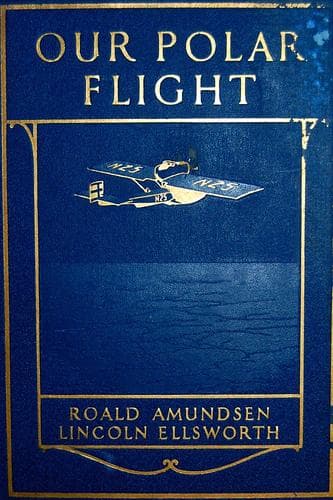
Aeronautics -- Flights; Arctic regions; North Pole
“Hobby” moves off; the course is set northwards to the ice-edge;
we shall steer past it westwards until we reach a point north of
Norskeöene. The trip back to Virgo-havn on Danskeöen has started. After
a few hours we near the ice-edge again, directly west of Ross-öen, and
proceed along it: little by little Syvöene and Northeastland disappear
in the horizon and we see no more land. Northwards is only ice and the
edge stretches westward as far as we can see. We continue our course
past it at a distance of 50–100 meters. A fresh breeze is blowing from
the southward, which produces white crests on the waves--it must have
been blowing the whole of the previous day, because during the course
of the day we notice that the belts of drift-ice, which we passed
through on the way up, have disappeared. The wind has driven them
northwards and pressed them into the edge of the pack-ice.
On the trip along the ice-edge we help the crew in “blubbering” the
sealskins. During the work Wharton makes a strange discovery. The crew
he is working with had, during the war, served on the western front in
the same American division to which he had belonged.
Having finished with the “blubbering,” we see another polar bear. It
is standing on a high ice shoal at the extreme edge. We put a boat
out and row towards it, climb ashore, and try to get within shooting
range. Slowly we approach from shoal to shoal. In the excitement we
fire from too long a range; the bullet passes the bear, which becomes
alarmed, and, looking like a yellow-white streak on the drift-ice, it
jumps from one shoal to another and speedily disappears from sight.
Shall we leave it in peace or shall we try to find it again? We climb
an iceberg and sight the bear through the glasses some hundred meters
further ahead. One of the shots we fired after it when it sprang away
must have injured it, for it appears to be lame on one side. It is not
running any longer, but jogs along slowly over the ice. We follow it
with glasses. Then it stops, and we see it lying down at the foot of
a big iceberg about a kilometer from us. We speculate what to do. To
proceed across the pack-ice is impossible. Most of the shoals lying at
the outside are not sufficiently large to bear the weight of a man, and
between the bigger pieces there are either big cracks or wide openings
filled with mush and small lumps of ice.
Public-domain text, read in full here on John Shaqi.
Reviews
Reviews
No reviews yet
Be the first to share your thoughts on this work.
Elsewhere in the archive
Join the Discussion
Join the discussion
Sign in to leave a comment or review.
Sign InorCreate an account