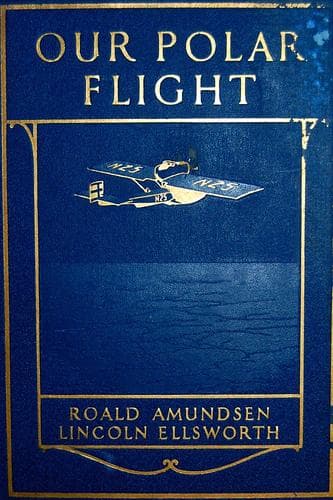
Aeronautics -- Flights; Arctic regions; North Pole
* After having sent in this report, the sad news had just been
received that Mr. Calwagen has been killed in a flying accident at
Kjeller, near Oslo, on the 10th of August, 1925. Immediately after
arriving home from Spitzbergen he commenced to work on that branch
which he was the first to start in Norway, namely, the reading
of the atmospheric conditions by self-registering instruments
installed in aeroplanes. In the course of the last year he has
personally taken part in many flights in order to complete the
registering-dials of the instruments from his own observations. The
accident happened during such a flight, just when he was engaged in
collecting observations for determining the atmospheric belts.
All who were with the expedition will no doubt remember Mr. Calwagen
as a practical man, helpful, impulsive, bubbling over with merriment,
capable but at the same time possessed of a modesty which was the
natural result of his noble altruistic nature. We all feel very grieved
at such a man’s death.
When it was necessary to have two men for the pilot balloon ascents,
Mr. Calwagen got excellent assistance from ice-pilot Ness, who,
according to what he himself said, was only too glad to be employed a
little on such an occupation during the long hours in which “Fram” lay
idle, not giving him enough to do.
Altogether sixty-two pilot balloons were sent up between the 15th
of April and the 29th of May. It was possible to follow one of them
through glasses to a height of 10,500 meters. This, however, was only
possible because there was very little wind all the way up. Generally
the wind was so strong that the balloon was lost sight of at a much
lower height.
It will lead us too far into scientific spheres to describe all the
methods used in determining the weather conditions from weather-charts
and from observations which were made. I shall have to content myself
by just mentioning the main principles which must be taken into
consideration when choosing the starting day.
It is the general experience that the regions which have low air
pressure mostly have cloudy weather and rainfall, whilst places with
high air pressure have fine weather with a clear sky. The point was
therefore to avoid conditions where a depression was moving towards the
Pole.
Public-domain text, read in full here on John Shaqi.
Reviews
Reviews
No reviews yet
Be the first to share your thoughts on this work.
Elsewhere in the archive
Join the Discussion
Join the discussion
Sign in to leave a comment or review.
Sign InorCreate an account