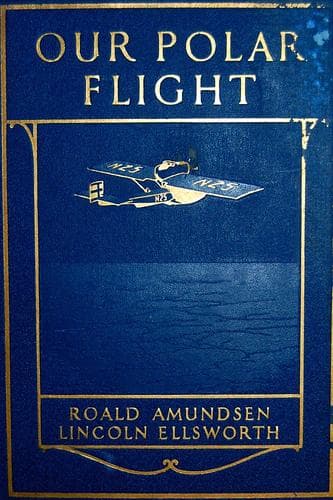
Aeronautics -- Flights; Arctic regions; North Pole
All these observations led to the following result: “Conditions to-day
are as favorable as can be expected so late in the summer. It was not
without nervousness that I advised the airmen of this result on the
morning of the 21st--never have I given a weather forecast with such a
heavy sense of responsibility. It was almost weighing me down with its
fateful importance, but on the other hand it was bracing to note how
the airmen arrived at their _much more responsible_ decision: “We start
to-day.”
And it was so! The last reports which were received at midday did
not show any change for the worse, so there was not the slightest
reason for calling off the start. The sky grew clearer continually;
Mr. Calwagen had the opportunity of following the ascension of a
pilot balloon with binoculars to a height of 4,000 meters. It showed
a northeasterly wind, apart from the lowest belt, where the wind blew
southeast from King’s Bay. The northeast wind high up had a speed of
between eighteen to twenty kilometers per hour. Therefore if this
strength should continue throughout the eight hours of the flight
towards the Pole, it would give the planes a deviation of 130–160
kilometers. So much petrol was to be kept in reserve that the last
stretch could also be flown, especially if one could reckon on the wind
being _with_ the planes throughout the flight homeward. Mr. Calwagen
wrote down the results of the pilot’s calculations and handed them over
to Captain Amundsen to assist him in the work of navigation.
Herewith the task of the meteorologists was ended, and in the last
unforgettable minutes we all stood as spectators, filled with
admiration for the six brave men who smilingly said good-by as if
they were just going on an everyday flying-trip. Not long afterwards
both machines were out of sight in the bright blue sky flying in the
direction of Cape Mitra.
* * * * *
Forty-five days later the polar flyers are home in Oslo again and
Captain Amundsen and Ellsworth’s meteorological notes are handed over
to us. We read them through with excitement. They contain news from
that part of the world which otherwise is out of the meteorologists
reach. They give him something to think about--especially after he has
dared to predict what kind of weather the polar flyers were likely to
meet in the unknown.
We start with the reports referring to the very beginning of the flight
from King’s Bay and see what the meteorological notes tell us.
After flying along the coast and passing the seven glaciers, the flyers
find Danskeöen’s and Amsterdamöen’s hills enveloped in fog which
continues northwards as far as the eye can see. What can this have been
caused by?
Public-domain text, read in full here on John Shaqi.
Reviews
Reviews
No reviews yet
Be the first to share your thoughts on this work.
Elsewhere in the archive
Join the Discussion
Join the discussion
Sign in to leave a comment or review.
Sign InorCreate an account