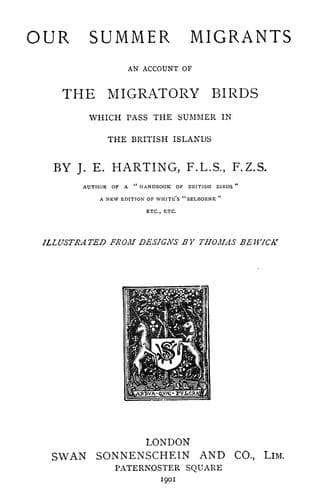
Our Summer Migrants: An Account of the Migratory Birds Which Pass the Summer in the British Islands.Harting, James Edmund
Science
Our Summer Migrants: An Account of the Migratory Birds Which Pass the Summer in the British Islands.
Harting, James Edmund
Birds -- Great Britain
It is annually observed in Malta in spring and autumn, but never found
there during the winter months (Wright, “Ibis,” 1864, p. 61). Lieut.
Sperling, however, believes that it is not uncommon on the north coast
of the Mediterranean in winter. South of the habitat assigned to it,
this bird ranges through Abyssinia (whence I have seen a specimen in the
collection of African birds belonging to Mr. Sharpe) to Mozambique,
where, according to Lieut. Sperling, it is plentiful in winter; and Mr.
Layard has included it amongst the birds of South Africa, having
received specimens from Windvogelberg and the Knysna. It has a West
African representative in _Anthus Gouldii_ of Frazer (Hartlaub, “Orn.
West Afr.,” p. 73), which differs in its smaller size and darker colour,
and in having the head of a uniform dull brown, instead of being
streaked.
THE PENNSYLVANIAN PIPIT.
(_Anthus ludovicianus._)
On the authority of several good naturalists this species is stated to
have occurred several times in the British Islands; but the general
description of the specimens referred to applies as a rule so well to
the _Anthus spinoletta_ above mentioned, that it is extremely difficult
to say to which of the two species they belonged. It is of course far
more probable that the visitors to our shores would be of European, not
American, extraction. At the same time they have been described as
according so well in every respect with the American _ludovicianus_,
that we must either admit that the latter bird occasionally visits this
country, or agree with Richardson and Swainson (“Faun. Bor. Americana,”
ii. p. 231) that it is indistinguishable from _aquaticus_ of Bechstein,
that is, _spinoletta_ of Linnæus.
Edwards was the first to notice this bird as a visitant to England,
giving a description and figure of a specimen obtained near London in
his “Gleanings” (vol. ii. p. 185, pl. 297). Montagu shortly afterwards
noticed two in his “Ornithological Dictionary,” one of which had been
taken in Middlesex, the other near Woolwich.
Macgillivray, in his “Manual of British Birds,” p. 169, minutely
describes two Pipits which were shot near Edinburgh in June, 1824, and
which he identifies clearly with the American species.
Mr. Turnbull, in his “Birds of East Lothian,” states (p. 40) that three
Pennsylvanian Pipits were shot at Dunbar in East Lothian by Mr. Robert
Gray, of Glasgow.
Mr. Bond has a Pipit, identified as belonging to this species, which was
obtained at Freshwater, in the Isle of Wight, in September, 1865; while
the most recent instance of the occurrence of this Pipit in England will
be found in the “Zoologist” for 1870. But anyone who reads the
correspondence relating to this instance (“Zool.” tom. cit. pp. 2021,
2067, and 2100) will see how difficult it is to identify a species when
the specimen is not in fully adult plumage.
Public-domain text, read in full here on John Shaqi.
Reviews
Reviews
No reviews yet
Be the first to share your thoughts on this work.
Elsewhere in the archive
Join the Discussion
Join the discussion
Sign in to leave a comment or review.
Sign InorCreate an account