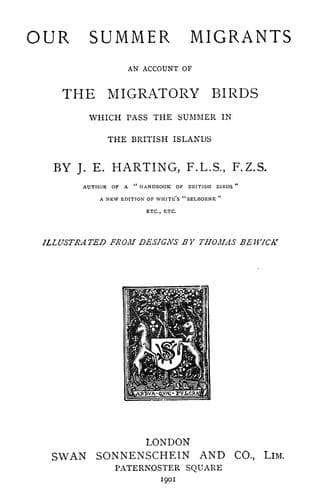
Our Summer Migrants: An Account of the Migratory Birds Which Pass the Summer in the British Islands.Harting, James Edmund
Science
Our Summer Migrants: An Account of the Migratory Birds Which Pass the Summer in the British Islands.
Harting, James Edmund
Birds -- Great Britain
Garden Warbler.
Blackcap.
Whitethroat.
Lesser Whitethroat.
Redstart.
Black Redstart.
Robin.
Reed Warbler.
Sedge Warbler.
Marsh Warbler.
Grasshopper Warbler.
Willow Wren.
Hedge Sparrow.
Common Wren.
Whinchat.
White Wagtail.
Grey-headed Wagtail.
Tawny Pipit.
Meadow Pipit.
Skylark.
Yellowhammer.
To this list Dr. Baldamus, from other sources, has added the
following:[98]—
Red-backed Shrike.
Barred Warbler.
Nightingale.
Icterine Warbler.
Chiff-chaff.
Great Reed Warbler.
Sedge Warbler.
Fire-crested Wren.
Tree Pipit.
Crested Lark.
Wood Lark.
Common Bunting.
Black-headed Bunting.
Greenfinch.
Linnet.
Russet Wheatear.
And lastly, in a foot-note to Mr. Dawson Rowley’s article on the
Cuckoo,[99] in which the above lists were quoted, Professor Newton has
pointed out the authority which exists for including the following, at
least occasionally, amongst the foster parents of the young Cuckoo:—
House Sparrow.
Blue-throated Warbler.
Rock Pipit.
Chaffinch.
Blackbird.
Grasshopper Warbler.[100]
Great Titmouse.
Red-throated Pipit.
Mealy Redpoll.
Bullfinch.
Jay.
Song Thrush.
Magpie.
Turtle Dove.
Wood Pigeon.
He confirms, moreover, Mr. Rowley’s remark that the Cuckoo’s egg is
occasionally found in the nest of the Brambling (_Fringilla
montifringilla_).
I have still to name four species which are not included in any of the
above lists, _viz._, the Spotted Flycatcher, Yellow Wagtail, Grey
Wagtail, and Wheatear. They were noticed by me some years ago in the
first work I ever published.[101] In the case of the Wheatear, a nest of
that bird containing three eggs of the Wheatear and one of the Cuckoo
was placed under a clod, and in such a position as strongly to favour
the opinion of some naturalists that the Cuckoo first lays her eggs and
then deposits them with her bill in the nest.
Considering the amount of attention which has been bestowed upon the
Cuckoo by naturalists in every age down to the present, one would
suppose that every fact in connection with its life-history was now
pretty generally known. Such, however, is not the case. There are still
certain points which require investigation, and which, owing chiefly to
the vagrant habits of the bird, are not easily determined.
How can it be ascertained with certainty, for example, whether the same
hen Cuckoo always lays eggs of the same colour, or whether (admitting
this to be the case) she invariably lays in the nest of the same
species—that is, in the nest of that species whose eggs most nearly
approximate in colour to her own?
Public-domain text, read in full here on John Shaqi.
Reviews
Reviews
No reviews yet
Be the first to share your thoughts on this work.
Elsewhere in the archive
Join the Discussion
Join the discussion
Sign in to leave a comment or review.
Sign InorCreate an account