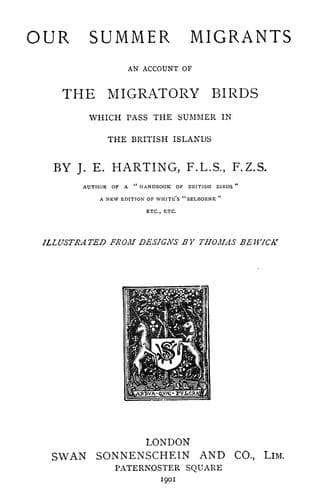
Our Summer Migrants: An Account of the Migratory Birds Which Pass the Summer in the British Islands.Harting, James Edmund
Science
Our Summer Migrants: An Account of the Migratory Birds Which Pass the Summer in the British Islands.
Harting, James Edmund
Birds -- Great Britain
The note of the Hoopoe is very remarkable, and not to be mistaken for
that of any other bird with which I am acquainted. It sounds like the
syllables “hoop-hoop,” “hoop-hoop,” frequently repeated, and in the
quality of its tone approximates to the call of the Cuckoo, but the
second note is a repetition of the first instead of being, as in the
case of the Cuckoo, a third below it. Old authors affirmed that this
peculiar sound was produced by the bird distending its cheeks with air,
and tapping its bill upon the ground, thereby causing the notes to
escape as it were spasmodically. This curious statement has received
some confirmation from the observations of Mr. Swinhoe.[109] He says:
“To produce these notes, the bird draws the air into its trachea, which
puffs out on either side of the neck, and the end of the bill is tapped
perpendicularly against a stone or the trunk of a tree, when the breath
being forced down the tubular bill produces the correct sound.” He adds,
however, that he has observed a Hoopoe perched upon a hanging rope, and
uttering its well-known cry without any tapping of the bill.
I cannot help thinking that a bird observed in the act of calling
_whilst picking up food_, as many species do, has given rise to the
notion that the sound is _produced_ by tapping, whereas in truth it
precedes and follows the movement. The only motion that I could ever
detect in a Hoopoe whilst calling was a nodding of the head, and a
depression of the crest-feathers.
From the accounts which have been handed down to us by old authors, and
the numerous specimens which may be seen preserved in old collections,
it would appear that the Hoopoe was formerly much more plentiful in
England than it is at the present day. The decrease in its numbers
probably arises from two causes, viz., the clearance of forest land,
entailing the destruction of many old trees which were once attractive
as nesting places,[110] and the increased use of fire-arms which
unfortunately results in the destruction of many of these beautiful
birds, at a time when they are just about to pair and commence
nidification.
The period of its migration into Europe in the spring sets in early in
April. The late Commander Sperling, when stationed with his vessel in
the Mediterranean, frequently met with Hoopoes at sea during their
passage. In the English Channel on the 15th April, 1854, a Hoopoe after
flying two or three times round a steamer entered one of the windows of
the saloon and was taken, apparently exhausted with fatigue. Another, on
the 21st April, alighted on a mackerel-boat between the Eddystone
Lighthouse and Plymouth Breakwater, in an exhausted state, and allowed
itself to be taken.
Public-domain text, read in full here on John Shaqi.
Reviews
Reviews
No reviews yet
Be the first to share your thoughts on this work.
Elsewhere in the archive
Join the Discussion
Join the discussion
Sign in to leave a comment or review.
Sign InorCreate an account