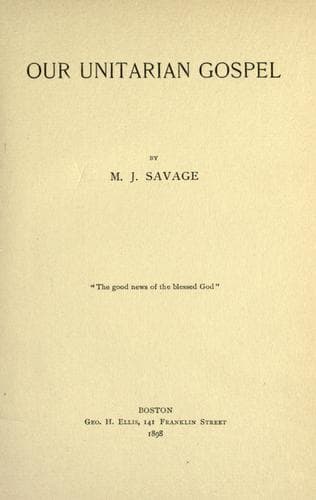
Our Unitarian GospelSavage, Minot J. (Minot Judson)
Religion
Our Unitarian Gospel
Savage, Minot J. (Minot Judson)
Sermons; Unitarianism
All these ideas, you see, are perfectly natural in certain stages of
human development, logically reasoned out in view of their thought of
the gods and of their relations to them and of what these gods must
desire at their hands. It is not only among the very early beliefs that
you find these ideas controlling the thought and action of men. Study
the ancient classical times as they are reflected in the Iliad, in the
Odyssey, or in Virgil's Aeneid, and you will find that the gods were
very human in all their feelings, their thoughts, their passions. As,
in the Old Testament, Yahweh is reported to have been a jealous God,
not willing that respect should be paid to anybody but himself, so you
find the old Greek and Roman deities very jealous as to what were
regarded as their rights, as to what the people must pay to them; and,
if they are angry, they can be appeased if an offering rare and costly
enough be brought by the worshipper. You can buy their favor; you can
ward off their anger, if only you can offer them something which is
precious enough so that they are ready to accept it at the worshipper's
hands.
These are not merely Old Testament ideas, nor only pagan ideas. Some
years ago, when I was in Rome, I visited among others one of the many
churches dedicated to Mary under one name or another; and there was a
statue of the Virgin by the altar, and it impressed me very much to see
that it was loaded down with gifts. Every place on the statue itself to
which anything could be attached, anything on the altar around it, was
weighted down with gold chains, with jewels, with precious gifts of
every kind. These had been brought as thank-offerings, expressions of
worship, or pledges connected with a petition, because I have brought
thee this gift, have mercy, do this for me which I need.
So these old ideas are vital still, and live on in the modern world.
And yet modern and magnificent are those utterances of the old Hebrew
prophet, who had so completely outgrown the common customs even of his
time, when he represents God as saying that he is weary of all these
external offerings. He says: I do not want the cattle brought to my
temples. Those that wander on a thousand hills are already mine. If I
were hungry, I would not ask thee. He does not want the rivers of oil
poured out. What does he want? The old prophet says, What doth the Lord
require of thee but to do justly, to love mercy, and to walk humbly
with God? And some of the later writers caught a glimpse of the same
spiritual truth when they said, Not burnt- offerings, not calves of a
year old; when they cry out, Shall I bring the fruit of my body for the
sin of my soul? No, it is a broken and contrite heart, a heart sorry
for its sin, a heart consecrating itself to righteousness and truth,
this inner, spiritual worship.
Public-domain text, read in full here on John Shaqi.
Reviews
Reviews
No reviews yet
Be the first to share your thoughts on this work.
Elsewhere in the archive
Join the Discussion
Join the discussion
Sign in to leave a comment or review.
Sign InorCreate an account