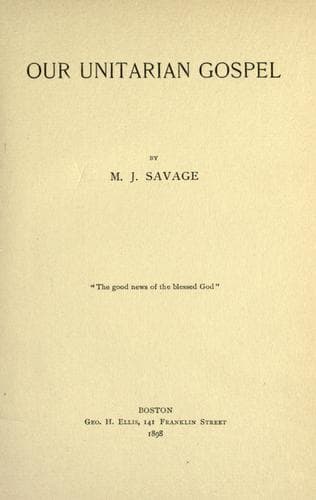
Our Unitarian GospelSavage, Minot J. (Minot Judson)
Religion
Our Unitarian Gospel
Savage, Minot J. (Minot Judson)
Sermons; Unitarianism
I shall not raise the question, which is rather curious than practical,
as to whether there are any beginnings of moral feeling in the animal
world below man. For our purpose this morning it is enough to note that
the minute that man appears conscience appears, and that conscience is
an act which springs out of social relations. In other words, when the
first man rose to the ability to look into the face of his fellow and
think of the other man as another self, like himself in feelings, in
possibilities of pleasure or pain, when this first man was able
imaginatively to put himself in: he place of this other, then morality
as a practical fact was Dorn.
We may imagine, for the purpose of illustration, this man saying: Here
is another being who appears to be like myself. He is capable of
suffering pain, as I am. He does not like pain any better than I do.
Therefore, I have no right to make him suffer that which I do not wish
to suffer myself. This other man is capable of pleasure. He desires
certain things, similar things to those which I desire. If I do not
wish him to take these things away from me, I have no right to take
them away from him.
I do not mean that this was thought out in this clear way, but that,
when there was the first dim perception of this other self, with
similar feelings, similar possibilities, similar pleasures, similar
pains, then there became a conscience, because there was a
consciousness of this similarity of nature. Morality, then, is born as
a social fact.
To go a little deeper, and in order to trace the natural and historical
growth of the moral ideal, let me say that morality in its deepest and
truest sense is born of the fact of sex, because it is right in there
that we find the root and the germ of permanent social relations. And I
wish you to note another very significant fact. You hear people talking
about selfishness and unselfishness, as though they were direct
contraries, mutually exclusive of each other, as though, in order to
make a selfish man unselfish, you must completely reverse his nature,
so to speak. I do not think this is true at all. Unselfishness
naturally and necessarily springs out of selfishness, and, in the
deepest sense of the word, is not at all contradictory to that.
For example: A man falls in love with a woman. This, on one side of it,
is as selfish as anything you can possibly conceive. But do you not see
by what subtle and divine chemistry the selfishness is straightway
transformed, lifted up, glorified, and becomes unselfishness? The very
love that he professes for her makes it necessary for his own happiness
that she should be happy, so that, in seeking for his own selfish
gratification, he is devoting himself unselfishly to the happiness of
somebody else.
Public-domain text, read in full here on John Shaqi.
Reviews
Reviews
No reviews yet
Be the first to share your thoughts on this work.
Elsewhere in the archive
Join the Discussion
Join the discussion
Sign in to leave a comment or review.
Sign InorCreate an account