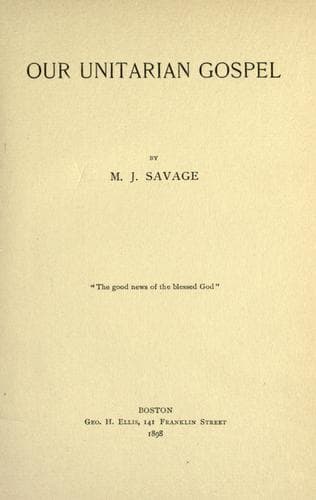
Our Unitarian GospelSavage, Minot J. (Minot Judson)
Religion
Our Unitarian Gospel
Savage, Minot J. (Minot Judson)
Sermons; Unitarianism
I am not casting any aspersion on the South in what I am saying, none
whatever. Were the conditions reversed, perhaps we should be no better.
It is not a practical problem with us. If there were two or three times
as many colored men in the State of New York as there are white men,
then we might understand the question. Let us not mentally cast any
stones at the people across the line. I point it out simply as
illustrating the difficulty that we have in recognizing the rights, the
moral rights, of people beyond the limits of that sympathy to which we
have been accustomed and for a long period trained.
I believe the day will come when we shall be as jealous of the right of
a man as we are now of the right of an American. We are not yet. There
have been foregleams and prophecies of it in the past. Long ago a Latin
writer said, I am a man, and whatever is human is not foreign to me.
But think what a lone and isolated utterance that has been for hundreds
of years. Jesus taught us to pray, not my Father, but our Father, and
we do pray it every day in the-year; but how many are the people in any
of the churches that dream of living it? A hundred years ago that
heretic, who is still looked upon as the bugaboo of all that is fine
and good, Thomas Paine, wrote, "The world is my country, and to do good
is my religion," a sentence so fine that it has been carved on the base
of the statue of William Lloyd Garrison on Commonwealth Avenue in
Boston, as being a fitting symbol of his own philanthropic life.
How many of us have risen to the idea of making these grand sentiments
the ruling principles of our lives? But along the lines of moral growth
it is to come. The day will be when, as I said, we shall feel as keenly
whatever touches the right of any man as to-day we feel that which
touches the right of one of our own people; and the moral growth of the
world will reach beyond that. I love to dream of a day when men will no
longer forget the inherent rights of any inhabitant of the air or of
the waters or of the woods or any of the domesticated animals that we
have come to associate with our lives.
Public-domain text, read in full here on John Shaqi.
Reviews
Reviews
No reviews yet
Be the first to share your thoughts on this work.
Elsewhere in the archive
Join the Discussion
Join the discussion
Sign in to leave a comment or review.
Sign InorCreate an account