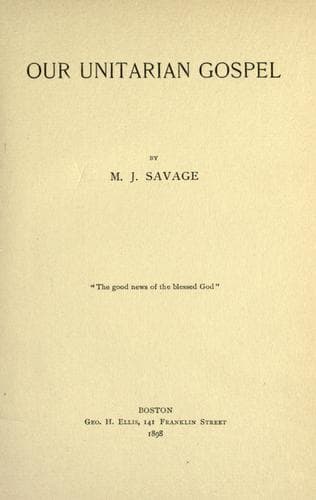
Our Unitarian GospelSavage, Minot J. (Minot Judson)
Religion
Our Unitarian Gospel
Savage, Minot J. (Minot Judson)
Sermons; Unitarianism
These are some of the reasons there are worthier ones than these which
influence the crowd. There are, I say, worthier ones. Let me hint one
or two. I do not think it is any sacrilege, or betrayal of confidence,
for me to speak a name. The late Frances E. Willard, one of the ablest,
truest, most devoted women I have ever known, frankly confessed to me
in personal conversation that she was more in sympathy with my
religious ideas than of those of the Church with which she was
connected, but her love, her tender love and reverence for her mother
and the memory of her mother's religion were such that she could not
find it in her heart to break away. She loved the services her mother
loved, she loved the hymns her mother sung, she loved the associations
connected with her mother's life. All sweet, beautiful, noble; but, if
nobody from the beginning of the world had ever advanced beyond
mothers' ideas where should we be to-day? Is it not, after all, the
truest reverence for mother, in the spirit of consecration she showed
to follow the truth as you see it to-day, as she followed it as she saw
it yesterday?
So much to justify the statement I made, that the average popular
belief on any subject is not a reliable guide to a person who is
earnestly desiring to find the simple truth.
Now let us come to the answer of the specific question which I have
propounded. Why are not all educated people Unitarians? I ask this
question, not because I originated it, but because it has been put to
me, I suppose, a hundred times. People say, You claim to have studied
these matters very carefully, you have tried to find the truth, you
think you have found it. You have followed what you regard as the true
method of search. If you have found the truth, and if other people,
using this same method and being as unbiased as you, could also find
it, how does it happen that Unitarians are in the minority? Why do not
all persons who study and who are educated accept the Unitarian faith?
This question, I say, has been asked me a great many times; and it is a
question that deserves a fair, an earnest and sympathetic answer. Such
an answer I am now to try to give.
In the first place, let me make a few assertions. I have not time to
prove them this morning; but they are capable of proof. The advantage
of a scientific statement is that, though you do not stop to prove it,
you know it can be proved any time, whenever a person chooses to take
the time or trouble. For example, if I state the truth of the
Copernican system, or that the earth revolves around the sun, and you
challenge me to prove it in two minutes, I may not be able to; it may
take longer than that; but I know it can be demonstrated to-morrow or
next week or any time, because it has been demonstrated over and over
again.
Public-domain text, read in full here on John Shaqi.
Reviews
Reviews
No reviews yet
Be the first to share your thoughts on this work.
Elsewhere in the archive
Join the Discussion
Join the discussion
Sign in to leave a comment or review.
Sign InorCreate an account