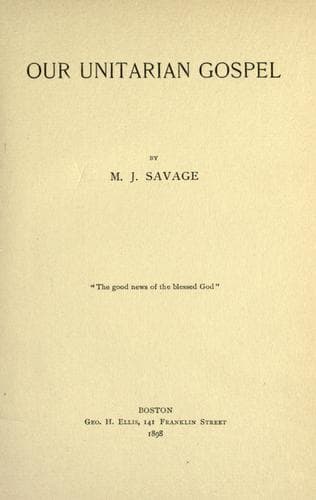
Our Unitarian GospelSavage, Minot J. (Minot Judson)
Religion
Our Unitarian Gospel
Savage, Minot J. (Minot Judson)
Sermons; Unitarianism
Now, in the second place, I want to dwell a little on the difficulty of
people's getting rid of a theory which possesses their minds, and
substituting for it another theory. And I wish you to note that it is
not a religious difficulty nor a theological difficulty nor a Baptist
difficulty nor a Presbyterian difficulty: it is a human difficulty.
There is no body of people on the face of the earth that is large
enough to contain all the world's bigotry. It overflows all fences and
gets into all enclosures. Discussing the subject a little while ago, by
correspondence with a prominent scientific man in New England, I got
from him the illustrations which I hold in my hand, tending to set
forth how difficult it is for scientific men themselves to get rid of a
theory which they have been working for and trying to prove, and
substitute for it another theory. I imagine that there may be a
physiological basis for the difficulty. I suggest it, at any rate. We
say that the mind tends to run in grooves of thought. That means, I
suppose, that there is something in the molecular movements of the
brain that comes to correspond to a well-trodden pathway. It is easy to
walk that path, and it is not easy to get out of it. Let it rain on the
top of a hill; and, if you watch the water, you will see that it seeks
little grooves that have been worn there by the falling of past rains,
and that the little streams obey the scientific law and follow the
lines of least resistance. There comes a big shower, a heavy downfall;
and perhaps it will wash away the surface and change the beds of these
old watercourses, create new ones. So, then, when there comes a deluge
of new truth, it washes away the ruts along which people have been
accustomed to think; and they are able to reconstruct their theories.
Now let me give you some of these scientific illustrations. First, that
heat is a mode of motion was proved by Sir Humphry Davy and Count
Rumford before 1820. In 1842 Joule, of Manchester, England, proved the
quantitative relation between mechanical energy and heat. In 1863 note
the dates Tyndall gave a course of lectures on heat as a mode of
motion, and was even then sneered at by some scientific men for his
temerity. Tait, of Glasgow, was particularly obstreperous. To-day
nobody questions it; and we go back to Sir Humphry Davy and Count
Rumford for our proofs, too. It was proved scientifically proved then;
but it took the world all these years, even the scientific world, to
get rid of its prejudices in favor of some other theory, and see the
force of the proof.
Public-domain text, read in full here on John Shaqi.
Reviews
Reviews
No reviews yet
Be the first to share your thoughts on this work.
Elsewhere in the archive
Join the Discussion
Join the discussion
Sign in to leave a comment or review.
Sign InorCreate an account