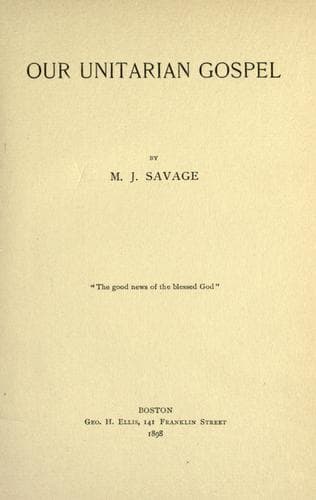
Our Unitarian GospelSavage, Minot J. (Minot Judson)
Religion
Our Unitarian Gospel
Savage, Minot J. (Minot Judson)
Sermons; Unitarianism
So much, then, for a statement as to what constitutes the Evangelical
Church, as to what must be the message of the minister who is to preach
"the gospel of Christ."
Now I wish to call your attention for a moment to another way of
looking at these doctrines. I am not to question their truth. I simply
wish to ask you to note as to whether, considering them true, we should
be inclined to speak of them as good news. Are they a gospel? Can we
with gladness proclaim them to men? For example, suppose God, after
creating the world, loses control of it, an evil power comes in, his
enemy, takes possession of his fair earth, alienates from him the
hearts of the only two of his children who are in existence here, and
who are to be the parents of a countless race. Suppose that is true. Is
it something we would like to believe? Is it good news? Can we call it
an integral part of a gospel?
Suppose, again, that God writes a book, an infallible book, and gives
it to whom? To a few people, to the little company of Jews who lived on
that little narrow strip of land on the eastern shore of the
Mediterranean. He does not give it to anybody else. He has given,
indeed, according to this theory, the Old Testament and the New to
Christendom since that day. But think a moment.
According to what we know to be true now, man was on this planet for
two or three hundred thousand years before God revealed himself at all;
and the race went stumbling on and falling in darkness, no light, no
hand stretched out to help, no voice speaking out of the silent
heavens, the world, apparently, absolutely forgotten, so far as God's
truth was concerned. Suppose that, after two or three hundred thousand
years, God did give an infallible book to the world. As I had occasion
to say a moment ago, comparatively a very small part of his children
have heard anything about it. And, then, what is very striking, the
proofs of its having come from him are so weak that most of the wisest,
the best, the noblest of the world, cannot accept any such claim on its
behalf. Is this, if it be true, good news? Would we speak of it as a
gospel, something of which to be glad, something to proclaim to mankind
as a cheer, a message from on high?
Once more, suppose, after the world had been in existence for two or
three hundred thousand years, God comes down, incarnates himself, wears
a human body, and does what he can to save men. If it is true, in the
economy of the divine government, that human souls could be saved in no
other way, is that good news? Would we think of it as a gospel to
proclaim to mankind, that God himself must suffer, must be outcast, be
spit upon, be reviled, be put to death, and that only so could he
forgive one of his wandering children, and bring him back to himself?
Public-domain text, read in full here on John Shaqi.
Reviews
Reviews
No reviews yet
Be the first to share your thoughts on this work.
Elsewhere in the archive
Join the Discussion
Join the discussion
Sign in to leave a comment or review.
Sign InorCreate an account