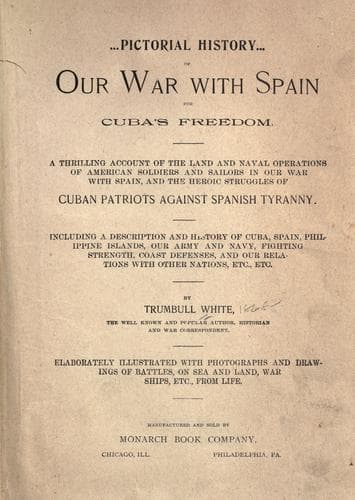
Our War with Spain for Cuba's FreedomWhite, Trumbull
History
Our War with Spain for Cuba's Freedom
White, Trumbull
Cuba -- History; Spain -- Foreign relations -- United States; Spanish-American War, 1898; United States -- Foreign relations -- Spain
"The question of the proposed reforms is not a matter which at all
concerns those who have already established an independent
government in Cuba and have resolved to shrink from no sacrifice
of property or life in order to emancipate the whole island from
the Spanish yoke. If the Spanish residents of the island who are
favored by the Spanish government with all sorts of privileges and
monopolies, and if the handful of Cubans, too pusillanimous or too
proud to acknowledge their error, or a few foreigners guided only
by selfish interests, are satisfied that Cuba should remain under
Spanish domination, we who fight under the flag of the solitary
star, we who already constitute the Republic of Cuba, and belong
to a free people with its own government and its own laws, are
firmly resolved to listen to no compromise and to treat with Spain
on the basis of absolute independence for Cuba.
"If Spain has power to exterminate us, then let her convert the
island into a vast cemetery; if she has not and wishes to
terminate the war before the whole country is reduced to ashes,
then let her adopt the only measure that will put an end to it and
recognize our independence. Spain must know by this time that
while there is a single living Cuban with dignity--and there are
many thousands of them--there will not be peace in Cuba, nor even
hope of it.
"All good causes must finally triumph, and ours is a good cause.
It is the cause of justice treated with contempt, of right
suppressed by force, and of the dignity of a people offended to
the last degree.
"We Cubans have a thousandfold more reason in our endeavors to
free ourselves from the Spanish yoke than the people of the
thirteen colonies had when in 1776 they rose in arms against the
British government.
COMPARISONS WITH THE AMERICAN COLONIES.
"The people of these colonies were in full enjoyment of all the rights
of man; they had liberty of conscience, freedom of speech, liberty of
the press, the right of public meeting and the right of free locomotion;
they elected those who governed them, they made their own laws and, in
fact, enjoyed the blessings of self-government. They were not under the
sway of a captain-general with arbitrary powers, who at his will could
imprison them, deport them to penal colonies, or order their execution
even without the semblance of a court-martial. They did not have to pay
a permanent army and navy that they might be kept in subjection, nor to
feed a swarm of hungry employes yearly sent over from the metropolis to
prey upon the country.
Public-domain text, read in full here on John Shaqi.
Reviews
Reviews
No reviews yet
Be the first to share your thoughts on this work.
Elsewhere in the archive
Join the Discussion
Join the discussion
Sign in to leave a comment or review.
Sign InorCreate an account