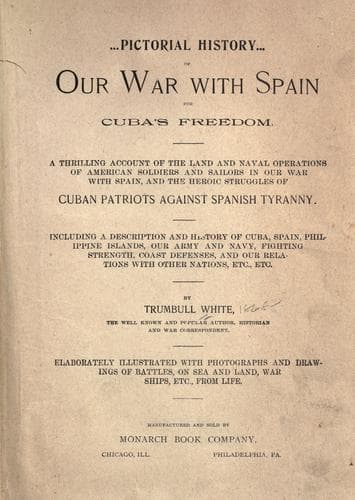
Our War with Spain for Cuba's FreedomWhite, Trumbull
History
Our War with Spain for Cuba's Freedom
White, Trumbull
Cuba -- History; Spain -- Foreign relations -- United States; Spanish-American War, 1898; United States -- Foreign relations -- Spain
Meantime the Cuban cavalry continued its course. By midnight it
had reached Cemetery Hill, overlooking the town of San Luis. The
moon was half way down the sky. Maceo sat upon his horse surveying
the scene below him long and silently. The little town was aglow
with electric lights and the whistle of locomotives resounded in
the valley. Over three thousand Spanish troops were quartered in
the town and their movements were plainly discernible. Trains were
arriving hourly from Santiago, bearing strong re-enforcements.
Through a field-glass Maceo watched the stirring scene. He turned
the glass beyond the town and gazed through it patiently,
betraying a trace of anxiety. Finally he alighted and conferred
with Colonel Miro, his chief of staff. A moment afterward came the
order to dismount. Three hundred troopers obeyed and were about to
tether their horses when they were called to attention. A second
order reached their ears. They were told to stand motionless, with
both feet on the ground, and to await further orders with their
right hands' on their saddles. In the moonlight beneath the
scattered palms they stood as silent as if petrified.
A STORY OF MACEO.
Among them there was a newspaper correspondent who had known Maceo
many years, and who had parted with him at Port Limon, in Central
America, a few months before. He had joined the column just after
the battle of Paralejo. In obedience to orders he stood with his
arm over the back of his horse, blinking at the enlivening scene
below him. Exhausted by the day's march, his eyes closed and he
found it impossible to keep awake. A moment later he fastened the
bridle to his foot, wrapped himself in his rubber coat, placed a
satchel under his head, and fell asleep in the wet grass. The
adjutant soon awoke him, telling him that he had better get up, as
they were going to have a fight. He thanked the adjutant, who told
him there were over three thousand Spanish soldiers in San Luis
and that it was surrounded with fourteen blockhouses. The
correspondent soon curled himself on the grass a second time and
was in a sound slumber, when he was again aroused by the adjutant,
who told him he was in positive danger if he persisted in
disobeying the order of General Maceo. A third time his heavy
eyelids closed and he was in a dead sleep, when startled by a
peremptory shake. Jesus Mascons, Maceo's secretary, stood over
him. "Get up this instant," said he. "The general wants to see you
immediately."
In a few seconds the correspondent was on his feet. The whistles
were still blowing and the electric lights still glowing in the
valley, and the moon was on the horizon. He went forward in some
trepidation, fancying that the general was going to upbraid him
for disobeying his orders. He was surprised to find him very
pleasant. Maceo always spoke in a low tone, as he had been shot
twice through the lungs.
"Are you not hungry?" he asked.
"No," the correspondent replied, wondering what was in the wind.
Public-domain text, read in full here on John Shaqi.
Reviews
Reviews
No reviews yet
Be the first to share your thoughts on this work.
Elsewhere in the archive
Join the Discussion
Join the discussion
Sign in to leave a comment or review.
Sign InorCreate an account