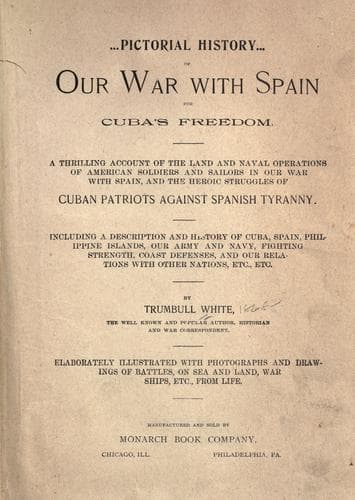
Our War with Spain for Cuba's FreedomWhite, Trumbull
History
Our War with Spain for Cuba's Freedom
White, Trumbull
Cuba -- History; Spain -- Foreign relations -- United States; Spanish-American War, 1898; United States -- Foreign relations -- Spain
The first misfortune which overtook the Spaniards was the rout of
Carnellas, on the very day on which Marin left Havana, Gomez sent
a detachment under Pedro Diaz to intercept him, and this force
reached Saladrigas in the early morning. In this section the
country is cut into small fields, divided by stone fences, and
facing the road there is a high fence, with a ditch in front of
it. Diaz placed 400 infantry behind this fence, and waited himself
with 1,000 cavalry back of a hill close by. When the Spanish
forces appeared, the advance guard was allowed to pass, and as
soon as the main body was fairly in the trap, volleys were poured
into them, literally mowing them down. At the sound of the first
gun, Diaz led his thousand horsemen upon the enemy's flank and
rear. The charge was irresistible. Half of Diaz's men did not even
fire a shot, but yelling "machete," they rode furiously upon the
Spanish lines, cutting their way through, and fighting with
terrible effect.
The Spanish issued no official report of this battle. So far as
the records show, it never occurred. One of the Spanish officers,
who fought in it, conceded a loss of 200 men, but it is probable
that twice that number would be nearer the correct figure.
AMERICANS IN THE CUBAN ARMY.
Colonel Frederick Funston, who returned to New York in January,
1898, told an interesting story of brave Yankee boys serving under
General Gomez and General Garcia in Eastern Cuba, and also gave an
account of the sad death of W. Dana Osgood, the famous football
player, formerly of the University of Pennsylvania.
Colonel Funston was with Gomez's army when they attacked Guimaro.
They had with them a twelve-pound Hotchkiss rifle and four
American artillerymen, Osgood of Pennsylvania, Latrobe and Janney
of Baltimore, and Devine of Texas.
They attacked Guimaro in the morning, at ranges of from 400 to 600
yards, the infantry being protected by a breastwork of earth, in
which openings were left for the guns.
The Spanish garrison consisted of 200 men in eleven forts, and
they maintained a hot fire all day. Gradually, however, the
Hotchkiss rifle, the fire of which was directed by Osgood, made
the largest and nearest fort untenable, and it was abandoned by
the garrison. No sooner had the Spanish forces left it than a band
of the insurgents took possession, and from this point of vantage
the fighting was continued with renewed vigor. As soon as darkness
came on one of the Cuban guns was moved forward and stationed in
this fort, and on the following day a storm of shot and shell was
directed at the other forts.
Public-domain text, read in full here on John Shaqi.
Reviews
Reviews
No reviews yet
Be the first to share your thoughts on this work.
Elsewhere in the archive
Join the Discussion
Join the discussion
Sign in to leave a comment or review.
Sign InorCreate an account