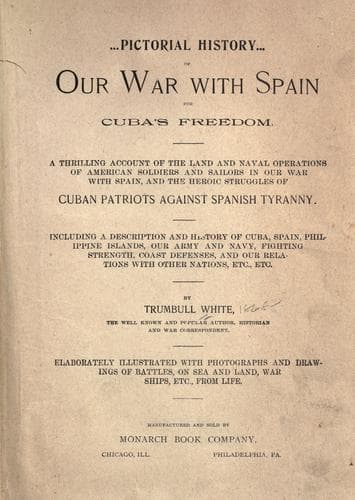
Our War with Spain for Cuba's FreedomWhite, Trumbull
History
Our War with Spain for Cuba's Freedom
White, Trumbull
Cuba -- History; Spain -- Foreign relations -- United States; Spanish-American War, 1898; United States -- Foreign relations -- Spain
His Ancestry--A Soldier From His Youth--He Succeeds General
Campos--A Master of Diplomacy--A Slave of Spain--His Personal
Appearance--His Interview With a Woman--His Definition of War--
His Resignation.
Early in 1896, when the Spanish government began to realize that
the insurrection was assuming serious proportions, arrangements
were made for the recall of General Campos, then Governor-General
of the island, and General Weyler was sent to assume the duties of
the office. It was the opinion in Spain that Campos was too mild
in his treatment of the rebels, and as Weyler was known to have no
lamb-like qualities, he was regarded as the ideal man for the
position. That he did not succeed in putting down the rebellion
was certainly not due to any lack of extreme measures on his part.
He is known as the "Butcher," and his management of affairs in
Cuba certainly gives him every right to the title.
Valeriano Weyler y Nicolau, to give him his full name, is only half a
Spaniard. His father was a Prussian, though Weyler himself was born in
Cadiz in 1839. His parents were in very moderate circumstances and not
of noble birth. What Weyler has won he has acquired through his own
efforts. He has made his way single-handed. He graduated from the
infantry school at Toledo in 1857 and was at once sent to Cuba as a
subaltern. He was quickly made a captain and his first work was to
subdue a small revolt in San Domingo.
He rose rapidly in rank, and during the first Cuban revolt he was
in command in the province of Santiago, where he earned the title
that has since made him famous in the eyes of his supporters, but
infamous from a civilized point of view. But he put down the
revolt. He was rewarded with the appointment of captain general of
the Canary islands. His administration was so successful that he
was created Marquis of Tenerife. He was then barely thirty-nine
years old. He distinguished himself in the Carlist war and at its
conclusion he was made captain general of the Philippines, where
he quelled an insurrection and admittedly gave the islands the
best administration they had ever known. He returned to Spain in
1889 and was in command at Barcelona until the present Cuban
revolution began.
Here is a mental photograph of him by a newspaper correspondent:
"Most men resemble their reputations, and if a life famously spent
is in the mind of one who visits a character of world-wide repute,
he quite naturally discovers peculiarities, of facial expression
and physique which appear to account for the individuality of the
man, fighter, philosopher, criminal, reformer or whatever he may
be.
Public-domain text, read in full here on John Shaqi.
Reviews
Reviews
No reviews yet
Be the first to share your thoughts on this work.
Elsewhere in the archive
Join the Discussion
Join the discussion
Sign in to leave a comment or review.
Sign InorCreate an account