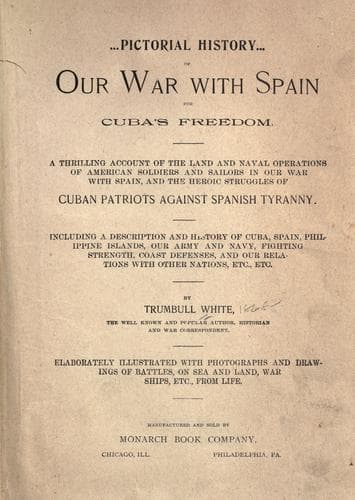
Our War with Spain for Cuba's FreedomWhite, Trumbull
History
Our War with Spain for Cuba's Freedom
White, Trumbull
Cuba -- History; Spain -- Foreign relations -- United States; Spanish-American War, 1898; United States -- Foreign relations -- Spain
Never was there a more genuine and typical American gentleman in a
difficult position where a genuine and typical American gentleman was
needed, than Fitzhugh Lee, the American consul-general at Havana during
the most critical time prior to the outbreak of our war with Spain. The
Cuban consul generalship is an office of much greater importance than
others of the same name in other countries where diplomatic
representatives are maintained. It includes the obligations of diplomacy
as well as those of commerce, and Lee was the man for both.
His predecessor in the office, Ramon Williams, had held the
position for many years and it was recognized by him as well as by
the authorities at Washington that a change should be made because
of the unusual demands upon the office. His long and faithful
service in the tropical country had undermined his health so that
his energies were lessened thereby, at a time when they were most
needed for the safety of American interests.
It was in the spring of 1896 that President Cleveland, believing
that a man of unusual ability should represent the United States
at Havana, chose Fitzhugh Lee for the post. The selection was
approved from the first by everyone who knew him, and not many
months had passed until General Lee became an idol and a hero of
the whole American people.
His Havana record has been no surprise to those who knew of his
exploits during the war, or of his family. Blood will tell, and it
has told in the case of General Lee. His family has always been
famous in American history. How could the grandson of "Lighthorse
Harry, the Revolutionary hero," or the nephew of Robert E. Lee, be
anything else but courageous and possessed of tact and common
sense?
The son of a naval officer, he preferred the army as a career.
Graduating from West Point, he fought on the frontier for six
years before the opening of the Rebellion, and was engaged in
several desperate encounters with the Comanche Indians in Texas.
On one of these occasions he was pierced through the lungs by an
arrow, but he lived to tell the story. On another occasion he
grappled with a big Indian in a hand-to-hand encounter, threw his
antagonist on the ground and killed him.
Though only twenty-seven years of age, Lee was an instructor in
cavalry tactics at West Point when the war broke out. He "followed
his State" into the secession movement. His war record is a matter
of pride to every Virginian. The dashing young officer was an
ideal trooper, fearing nothing and loved by his men. He was
modest, too. After some brilliant movement of personal valor his
brigade formed in a body and determined to serenade him at his
headquarters, expecting, of course, a speech. But Lee got an
inkling of the matter, and when he saw them coming he slipped out
of his tent and hid in the bushes. After the disappointed troopers
had called for him in vain and dispersed he peeped furtively from
his hiding place, and in a subdued tone asked, "Have they gone?"
Public-domain text, read in full here on John Shaqi.
Reviews
Reviews
No reviews yet
Be the first to share your thoughts on this work.
Elsewhere in the archive
Join the Discussion
Join the discussion
Sign in to leave a comment or review.
Sign InorCreate an account