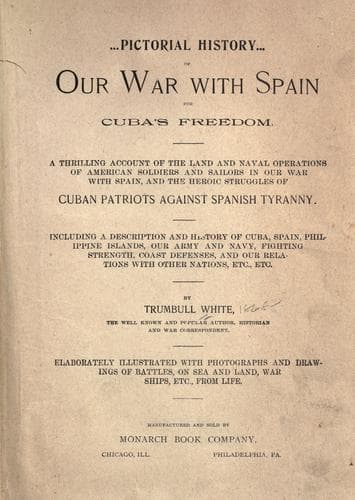
Our War with Spain for Cuba's FreedomWhite, Trumbull
History
Our War with Spain for Cuba's Freedom
White, Trumbull
Cuba -- History; Spain -- Foreign relations -- United States; Spanish-American War, 1898; United States -- Foreign relations -- Spain
After the war had ended, General Lee settled in Stafford County as
a farmer and miller. His life was the quiet and uneventful one of
a country gentleman, caring for nothing but his wife, whom he
married in 1871, and his children. About 1875 he began to take an
active part in politics, and he attended the national convention
of 1876 as a delegate. In 1885 he was elected governor of
Virginia. It was then that he again became conspicuous. General
Lee headed the southern division of the inauguration parade, and
his handsome presence and splendid horsemanship forced the men on
the sidewalks to cheer him with more vim than they did anyone
else. A similar demonstration occurred when, four years later,
General Lee led the Virginia troops in the Washington centennial
parade in New York to the stirring tune of "Dixie." On both of
these occasions he sat in the identical saddle which his uncle,
General Robert E. Lee, had used on his familiar gray war horse,
Traveler. Who could occupy it more worthily? Any one who has seen
"Fitz" Lee mounted like a centaur on a Virginia thoroughbred is
certain to have in memory ever afterward an ideal figure of a
knightly "man on horseback." Afoot he is not so imposing, being
only of medium stature, and, of late years, quite portly. He has a
fine head and face, with frank steel blue eyes and a ruddy
complexion, set off by his now almost white hair, mustache and
imperial. His bearing is alert and military. Altogether, he does
not look, and probably does not feel, his sixty-two years.
During Mr. Cleveland's second term he was made collector of
internal revenue at Lynchburg, Va.
THE MAN FOR THE PLACE AT HAVANA.
Once settled in his position in Havana, General Lee's fame began
to multiply. The American opinion of him was voiced immediately
after the destruction of the Maine, by L. P. Sigsbee, the brother
of the commander of that ill-fated ship, when he said: "There's a
man down there looking after the interests of this country who
cannot be blinded. He has more sand than anybody I know of, and if
there's anything treacherous in this explosion we'll know of it
without delay. The man I mean is General Fitzhugh Lee."
The same thought occurred to every American who had watched his
career. From first to last everybody had confidence in his
Americanism, his bravery and his cool-headedness. He held his
office through merit alone, no politician gaining any success in
the effort to win from him that position of distinction and
profit, after the change of administration when President McKinley
assumed the executive chair. The nation recognized that he was
first an American and an interference with him on partisan grounds
would not have been tolerated.
Jealous of American honor, and firm in insisting upon the rights
of his countrymen, he has always kept cool. Courteous and polite
as well as courageous, he has never blustered and he has won the
respect and admiration of the Spaniards as well as their fear.
Public-domain text, read in full here on John Shaqi.
Reviews
Reviews
No reviews yet
Be the first to share your thoughts on this work.
Elsewhere in the archive
Join the Discussion
Join the discussion
Sign in to leave a comment or review.
Sign InorCreate an account