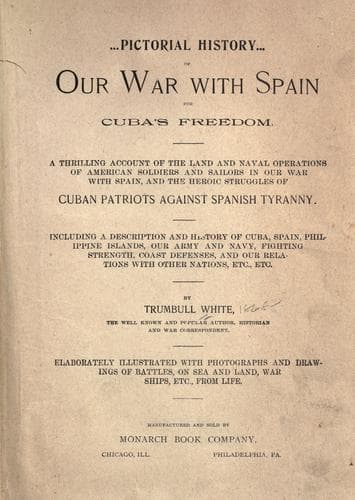
Our War with Spain for Cuba's FreedomWhite, Trumbull
History
Our War with Spain for Cuba's Freedom
White, Trumbull
Cuba -- History; Spain -- Foreign relations -- United States; Spanish-American War, 1898; United States -- Foreign relations -- Spain
Dr. Zertucha surrendered to a Spanish officer shortly after Maceo
was killed. He said that the dead leader was discouraged by the
continual failures of the insurgents to make any headway against
their foes; that, on account of his color, the subordinate
officers in the Cuban ranks did not show proper respect for him,
or obedience to his commands, and that he had purposely placed
himself in range of the enemy's rifles, deliberately seeking
death.
These statements are manifestly false, and go far to confirm the
belief that the coward who made them had a guilty knowledge
concerning the manner of the death of the brave soldier he
maligned.
AN ESTIMATE OF MACEO'S CHARACTER.
A gentleman who made Maceo's acquaintance in Havana, prior to the
present insurrection, gives this estimate of his character:
"Maceo was a natural politician in that he had the genius of
divining popular opinion, and taking the leadership of popular
movements. He was in Havana at that time sounding men and scheming
for the present revolution. He was always of the sunniest
disposition, closely attaching all people to him, and a man of the
strictest moral integrity. He never drank wine, he never smoked,
and that in a land where tobacco is as common as potatoes in
Ireland, and he never played cards. He had a great abhorrence of
men who drank to excess, and would not tolerate them about him.
"He always dressed, when in Havana, in the most finished style.
His massive frame--he was about five feet ten inches in height and
unusually broad shouldered--was displayed to advantage always in
frock coat, closely buttoned, and he usually wore a silk hat. He
was neat, even to fastidiousness, in his dress. He usually carried
a cane.
"When Maceo took the field, however, he roughed it with his men,
and dressed accordingly. When in battle he carried a long-barreled
38-caliber revolver with a mother-of-pearl handle, and a Toledo
blade made in the form of a machete. The handle of this machete
was finely wrought silver and turquoise shell, and had four
notches in it, into which the fingers could easily fit. Maceo
always had three horses with him on his marches, the favorite
being a big white one."
Probably no event in the war up to that time caused such general
satisfaction among the supporters of the existing government, both
in Cuba and in Spain, as the death of Maceo. When Jose Marti was
killed, they were certain that the loss of that leader would
compel the insurrectionists to abandon hopes of success. On the
contrary, it inspired them with greater determination than before.
But the Spanish sympathizers learned nothing from that experience,
and when it was definitely known that Maceo was no longer to be
feared, they were unanimous in the belief that the end of the
struggle was at hand. Subsequent events have shown how little they
knew of the kind of men with whom they were at war.
Public-domain text, read in full here on John Shaqi.
Reviews
Reviews
No reviews yet
Be the first to share your thoughts on this work.
Elsewhere in the archive
Join the Discussion
Join the discussion
Sign in to leave a comment or review.
Sign InorCreate an account