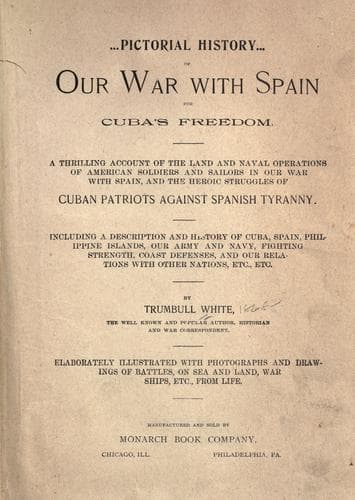
Our War with Spain for Cuba's FreedomWhite, Trumbull
History
Our War with Spain for Cuba's Freedom
White, Trumbull
Cuba -- History; Spain -- Foreign relations -- United States; Spanish-American War, 1898; United States -- Foreign relations -- Spain
"Then the litter was carried into the cane field. This young man
said: 'You must immediately write to the American consul. I will
furnish you with a messenger, and you may rest safely in this cane
field with your son. I will put a guard of 500 men around it so
that they cannot burn it, as they do when they know people are
hiding in the cane.'
"For five days I was in the cane field with my son. It rained upon
us, and then I put the pillows over my son's chest, in order to
protect him. I suffered greatly from rheumatism. Only the young
man appeared and said that General Maceo had sent a guard to
escort me back to my home. With my boy we were taken there and
guard kept around our house. The messenger came back from the
Consul, and I came on to Havana to see General Weyler, who had my
son brought here to the city."
Stories of outrages on Americans that are unquestionably true
might be furnished in numbers sufficient to more than fill this
entire volume, but enough have been given to convince the most
skeptical that the demand for intervention was justified on our
own account, as well as for the sake of the people of Cuba.
CHAPTER XXXI.
McKINLEY SUCCEEDS CLEVELAND.
The Cuban Question Not a New One--The Efforts of Former
Administrations to Bring About a Settlement--President Cleveland's
Message--Recommendations of President McKinley--The Spanish
Minister's Insulting Letter--His Resignation Accepted--The Apology
of the Spanish Government.
For more than ninety years the United States government has been
confronted with a Cuban question. At times it has disappeared from
our politics, but it has always reappeared. Once we thought it
wise to prevent the island from winning its independence from
Spain, and thereby, perhaps, we entered into moral bonds to make
sure that Spain governed it decently. Whether we definitely
contracted such an obligation or not, the Cuban question has never
ceased to annoy us. The controversies about it make a long series
of chapters in one continuous story of diplomatic trouble. Many of
our ablest statesmen have had to deal with it as Secretaries of
State and as Ministers to Spain, and not one of them has been able
to settle it. One President after another has taken it up, and
every one has transmitted it to his successor. It has at various
times been a "plank" in the platforms of all our political
parties--as it was in both the party platforms of 1896--and it has
been the subject of messages of nearly all our Presidents, as it
was of President Cleveland's message in December, 1896, in which
he distinctly expressed the opinion that the United States might
feel forced to recognize "higher obligations" than neutrality to
Spain. In spite of periods of apparent quiet, the old trouble has
always reappeared in an acute form, and it has never been settled;
nor has there recently been any strong reason for hope that it
could be settled merely by diplomatic negotiation with Spain. Our
Public-domain text, read in full here on John Shaqi.
Reviews
Reviews
No reviews yet
Be the first to share your thoughts on this work.
Elsewhere in the archive
Join the Discussion
Join the discussion
Sign in to leave a comment or review.
Sign InorCreate an account