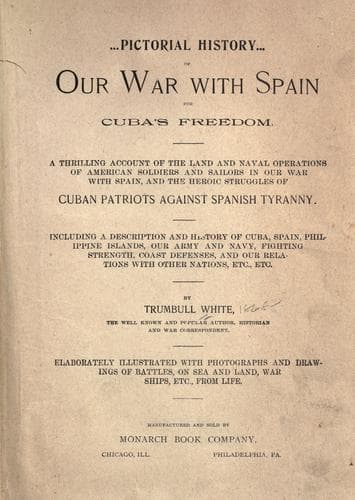
Our War with Spain for Cuba's FreedomWhite, Trumbull
History
Our War with Spain for Cuba's Freedom
White, Trumbull
Cuba -- History; Spain -- Foreign relations -- United States; Spanish-American War, 1898; United States -- Foreign relations -- Spain
The Red Cross relief boats made a complete and accurate list of
the Spanish prizes in the harbor--twenty-two in all--with the
numerical strength of every crew, the amount of provisions, if
any, on every vessel, and the quantity and kind of food that each
would require. This was at once provided, and thus almost the
first work done by the Red Cross in our war with Spain was the
feeding of representatives of a nation that had forced us into war
mainly because of its policy of starvation of the people of Cuba.
On the morning of June 20, the Red Cross steamer State of Texas
left Key West for Santiago, stocked with food and medicines, and
having on board Miss Barton, Mr. Kennan, and a complete working
force of doctors and nurses. They were warmly welcomed on their
arrival on Cuban shores, and the State of Texas was the first
American ship to enter the harbor of Santiago after the surrender.
The Red Cross has done a grand work on many battlefields in every
quarter of the globe, but never has it rendered more efficient aid
to suffering humanity than it did on the southern shores of the
island of Cuba. On the battlefield, braving the bullets of the
foe, in the hospitals, ministering to the wants of the wounded and
the dying, among the wretched non-combatants, giving food to the
starving, and nursing the fever-stricken refugees, these noble men
and women were ever ready to answer to the cry of the needy and
the helpless.
CHAPTER XXXIV.
THE CATASTROPHE TO THE MAINE.
The Board of Inquiry in Session--Its Report Received by Congress
--Spanish Officials in Cuba Show Sympathy--The Evidence of the
Divers--A Submarine Mine--The Officers and Men of the Maine
Exonerated--Responsibility Not Fixed.
The story of the destruction of the battleship Maine has already
been told in these pages. The Naval Board appointed to inquire
into the causes of the disaster was composed of the following
officers of the United States Navy: Captain Sampson, of the Iowa;
Captain Chadwick, of the New York; Captain Marix, of the Vermont,
and Lieutenant Commander Potter, of the New York.
After an investigation which lasted for more than three weeks,
this Board of Inquiry sent its report to President McKinley, who
transmitted it to Congress, accompanied by the following message:
To the Congress of the United States:
For some time prior to the visit of the Maine to Havana harbor our
consular representatives pointed out the advantages to flow from
the visits of national ships to the Cuban waters, in accustoming
the people to the presence of our flag as the symbol of good will
and of our ships in the fulfillment of the mission of protection
to American interests, even though no immediate need therefor
might exist.
Public-domain text, read in full here on John Shaqi.
Reviews
Reviews
No reviews yet
Be the first to share your thoughts on this work.
Elsewhere in the archive
Join the Discussion
Join the discussion
Sign in to leave a comment or review.
Sign InorCreate an account