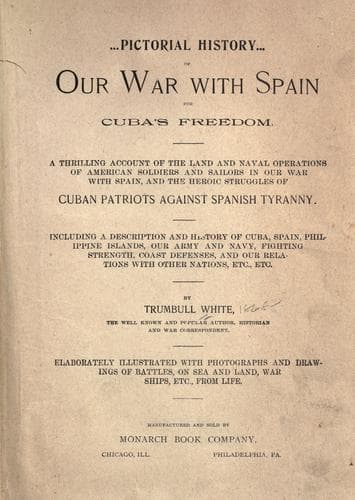
Our War with Spain for Cuba's FreedomWhite, Trumbull
History
Our War with Spain for Cuba's Freedom
White, Trumbull
Cuba -- History; Spain -- Foreign relations -- United States; Spanish-American War, 1898; United States -- Foreign relations -- Spain
The appalling calamity fell upon the people of our country with
crushing force and for a brief time an intense excitement
prevailed, which in a community less just and self-controlled than
ours might have led to hasty acts of blind resentment. This
spirit, however, soon gave way to the calmer processes of reason
and to the resolve to investigate the facts and await material
proof before forming a judgment as to the cause, the
responsibility, and, if the facts warranted, the remedy. This
course necessarily recommended itself from the outset to the
Executive, for only in the light of a dispassionately ascertained
certainty could it determine the nature and measure of its full
duty in the matter.
The usual procedure was followed, as in all cases of casualty or
disaster to national vessels of any maritime state. A Naval Court
of Inquiry was at once organized, composed of officers well
qualified by rank and practical experience to discharge the duties
imposed upon them. Aided by a strong force of wreckers and divers,
the court proceeded to make a thorough investigation on the spot,
employing every available means for the impartial and exact
determination of the causes of the explosion. Its operations have
been conducted with the utmost deliberation and judgment, and
while independently pursued, no source of information was
neglected and the fullest opportunity was allowed for a
simultaneous investigation by the Spanish authorities.
REPORT OF THE BOARD RECEIVED.
The finding of the Court of Inquiry was reached after twenty-three
days of continuous labor, on the 21st of March, and having been
approved on the 22d by the commander-in-chief of the United States
naval forces of the North Atlantic station, was transmitted to the
Executive.
It is herewith laid before Congress, together with the voluminous
testimony taken before the court. Its purport is in brief as
follows:
When the Maine arrived at Havana she was conducted by the regular
government pilot to Buoy No. 5, to which she was moored in from
five and one-half to six fathoms of water. The state of discipline
on board and the condition of her magazines, boilers, coal bunkers
and storage compartments are passed in review, with the conclusion
that excellent order prevailed and that no indication of any cause
for an internal explosion existed in any quarter.
At eight o'clock in the evening of February 15th everything had
been reported secure and all was quiet. At forty minutes past nine
o'clock the vessel was suddenly destroyed. There were two distinct
explosions with a brief interval between them. The first lifted
the forward part of the ship very perceptibly; the second, which
was more open, prolonged and of greater volume, is attributed by
the court to the partial explosion of two or more of the forward
magazines.
Public-domain text, read in full here on John Shaqi.
Reviews
Reviews
No reviews yet
Be the first to share your thoughts on this work.
Elsewhere in the archive
Join the Discussion
Join the discussion
Sign in to leave a comment or review.
Sign InorCreate an account