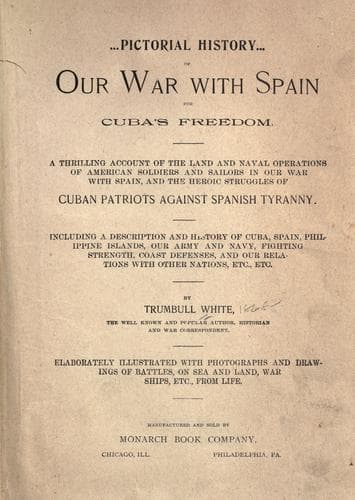
Our War with Spain for Cuba's FreedomWhite, Trumbull
History
Our War with Spain for Cuba's Freedom
White, Trumbull
Cuba -- History; Spain -- Foreign relations -- United States; Spanish-American War, 1898; United States -- Foreign relations -- Spain
The reply of the Spanish Cabinet was received on the night of the 31st
ultimo. It offers as the means to bring about peace in Cuba, to confide
the preparation thereof to the Insular Parliament, inasmuch as the
concurrence of that body would be necessary to reach a final result, it
being, however, understood that the powers reserved by the Constitution
to the central government are not lessened or diminished. As the Cuban
Parliament does not meet until the 4th of May nest, the Spanish
Government would not object, for its part, to accept at once a
suspension of hostilities if asked for by the insurgents from the
General-in-Chief, to whom it would pertain in such a case to determine
the duration and conditions of the armistice.
The propositions submitted by General Woodford and the reply of
the Spanish Government were both in the form of brief memoranda,
the texts of which are before me, and are substantially in the
language above given.
There remain the alternative forms of intervention to end the war,
either as an impartial neutral by imposing a rational compromise
between the contestants, or as the active ally of one party or the
other.
As to the first, it is not to be forgotten that during the last
few months the relation of the United States has virtually been
one of friendly intervention in many ways, each not of itself
conclusive, but all tending to the exertion of a potential
influence toward an ultimate pacific result just and honorable to
all interests concerned. The spirit of all our acts hitherto has
been an earnest, unselfish desire for peace and prosperity in
Cuba, untarnished by differences between us and Spain and
unstained by the blood of American citizens.
The forcible intervention of the United States as a neutral, to
stop the war, according to the large dictates of humanity and
following many historical precedents where neighboring States have
interfered to check the hopeless sacrifices of life by internecine
conflicts beyond their borders, is justifiable on rational
grounds. It involves, however, hostile constraint upon both the
parties to the contest, as well to enforce a truce as to guide the
eventual settlement.
GROUNDS FOR INTERVENTION.
The grounds for such intervention may be briefly summarized as
follows:
First. In the cause of humanity and to put an end to the
barbarities, bloodshed, starvation and horrible miseries now
existing there, and which the parties to the conflict are either
unable to or unwilling to stop or mitigate. It is no answer to say
this is all in another country, belonging to another nation, and
is therefore none of our business. It is specially our duty, for
it is right at our door.
Second. We owe it to our citizens in Cuba to afford them that
protection and indemnity for life and property which no government
there can or will afford, and to that end to terminate the
conditions that deprive them of legal protection.
Public-domain text, read in full here on John Shaqi.
Reviews
Reviews
No reviews yet
Be the first to share your thoughts on this work.
Elsewhere in the archive
Join the Discussion
Join the discussion
Sign in to leave a comment or review.
Sign InorCreate an account