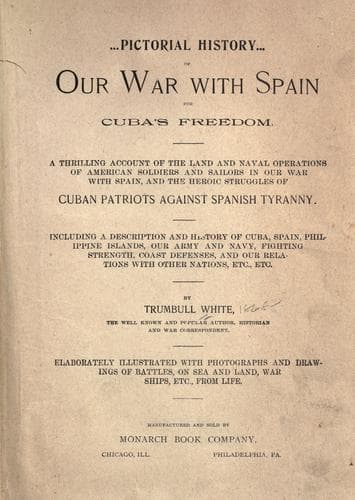
Our War with Spain for Cuba's FreedomWhite, Trumbull
History
Our War with Spain for Cuba's Freedom
White, Trumbull
Cuba -- History; Spain -- Foreign relations -- United States; Spanish-American War, 1898; United States -- Foreign relations -- Spain
On one point at least there was an accord of opinion in rank and
file--the camp was well named. "Camp George H. Thomas" they called
it, in memory of old "Pap," the hero of Chickamauga, and men and
officers alike took a very visible pride in being residents of the
tented city. The establishment of the community at Camp Thomas was
much like the establishment of a colony in an unsettled land, in
so far as domestic conveniences were concerned. Everything had to
be taken there, and each regiment, which was a small canvas town
in itself, had to depend entirely upon its own resources. Dotted
here and there throughout the entire expanse of the fifteen-mile
reservation, these cities of tents were seen, and the brave men
who lived in them depended upon themselves and each other for what
little entertainment they got. A description of the quarters of
one officer will serve for all. An "A," or wall tent, 10 by 12
feet, and some of them a size smaller, was his house. On one side
a folding camp cot, with a thin yet comfortable mattress and an
abundance of heavy, woolen army blankets. A table about twenty
inches square, with legs that fold up into the smallest possible
space, stood near the door at the foot of the cot. A folding chair
or two for his visitors, a large valise or a very small trunk, a
bit of looking glass hanging from a tent pole, a tubular lantern,
or, if the tenant of the tent was not so fortunate as to possess
such a modern light, then a candle attached to a stick in the
ground beside his bed. Tie strings attached to the rear wall of
the tent afforded a hanging place for "his other shirt" and a pair
of extra shoes. His leggings and boots were on his feet, and his
belt, pistol and saber stood in a corner. A pad of writing paper,
pocket inkstand, a razor strop, unless he had foresworn shaving, a
briar or corn-cob pipe, and a bag of tobacco completed the
furnishings of his house. Commanding officers, at regimental
headquarters, had an extra roof, or "tent fly," as an awning in
front of their quarters, but otherwise lived as other officers
did.
The enlisted men, quartered in the conical wall tents now adopted
by the army, bunked with heads to the wall and feet toward the
center, from nine to twelve in a tent Their bedding and blankets
were good and they were as comfortable as soldiers could hope to
be in the field. Some of the regiments from the remote Northwest
had the Sibley conical tent, which has no wall, but which has a
small sheet iron stove. These were more than appreciated during
the cold, rainy weather that prevailed at Camp Thomas.
Public-domain text, read in full here on John Shaqi.
Reviews
Reviews
No reviews yet
Be the first to share your thoughts on this work.
Elsewhere in the archive
Join the Discussion
Join the discussion
Sign in to leave a comment or review.
Sign InorCreate an account