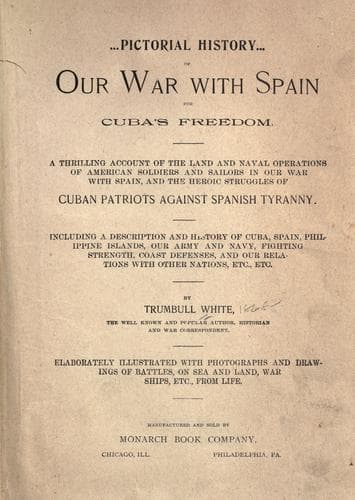
Our War with Spain for Cuba's FreedomWhite, Trumbull
History
Our War with Spain for Cuba's Freedom
White, Trumbull
Cuba -- History; Spain -- Foreign relations -- United States; Spanish-American War, 1898; United States -- Foreign relations -- Spain
Life in camp at Tampa was much the same as at Chickamauga, except
that the weather was much hotter. To offset this, however, the
boys had fine sea bathing, good opportunities for sailing parties,
and the best of fresh fish with which to leaven their rations of
salt horse and hardtack. It is astonishing how quickly a man
learns to forage and cook after joining the regular army. Three
months of service will transform the greenest of counter-jumpers
into an expert in the art of enticing chickens from their coops
and turning them into savory stews. One of the troopers of the
Ninth cavalry was called "Chickens," from his predilections in
this line. There were orders against foraging, of course; there
always are in friendly territory, but they never amount to much.
The officers knew they were disobeyed, but they winked the other
eye and said nothing. It is hinted that in this course may be
often found an explanation of the lavishness with which the
officers' mess is served. One night Major--was smoking a nightcap
cigar just outside his tent, when he caught sight of "Chickens"
stealing past in the shade of the trees. "Chickens" of course was
halted and asked why he was prowling around at that time of night.
Before the culprit could frame an excuse the Major noticed a
suspicious bulging of the front of the trooper's blouse, and an
uneasy, twisting motion within. It was plain to him that
"Chickens" had been foraging, and was getting back into quarters
with his plunder.
"Been foraging, hey?" said the Major. "Don't you know it's against
orders?"
"Chickens" stammered out a denial, when the Major, making a sudden
grab at the front of his blouse, tore it open, and out fell two
plump pullets.
"Stealing hens, hey?" said the Major. "You'll go to the clink for
this."
"Ah didn't dun steal 'em, Majah," said "Chickens," with brazen
effrontery. "Ah 'clar to goodness Ah didn't know dem pullets was
dar. Mus' have crawled into mah blous t' keep wahm, Majah."
The reply tickled the veteran so much that he let "Chickens" pass,
and the next morning there was one officer at the post who had
stewed pullet for breakfast.
One of the most famous regiments of infantry at Tampa was the
Thirteenth. It has the well-earned reputation of being a good
fighting body. Some of the most distinguished officers of the army
have been on its rolls in time past, among them Sherman and
Sheridan. The history of the Thirteenth goes back to May 14, 1861,
when President Lincoln directed its organization. The first
colonel was William T. Sherman, who re-entered the army after a
number of years engaged in banking and the practice of law. C. C.
Augur was one of the majors, and Philip H. Sheridan was a captain.
Sheridan joined the regiment in November, 1861, but was soon
appointed chief commissary and quartermaster to the Army of
Southwest Missouri, which practically severed his connection with
the regiment.
Public-domain text, read in full here on John Shaqi.
Reviews
Reviews
No reviews yet
Be the first to share your thoughts on this work.
Elsewhere in the archive
Join the Discussion
Join the discussion
Sign in to leave a comment or review.
Sign InorCreate an account