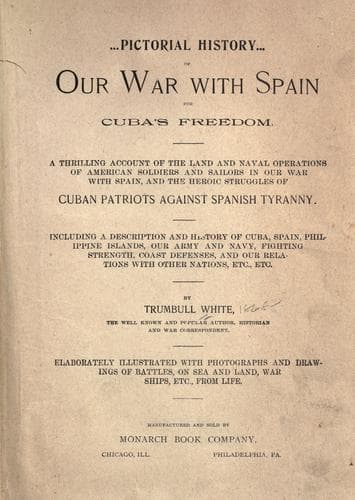
Our War with Spain for Cuba's FreedomWhite, Trumbull
History
Our War with Spain for Cuba's Freedom
White, Trumbull
Cuba -- History; Spain -- Foreign relations -- United States; Spanish-American War, 1898; United States -- Foreign relations -- Spain
If all the Spanish gunners had been suffering from strabismus
their practice could not have been worse. But the officers of both
the Morrill and Vicksburg frankly admit their own recklessness and
the narrow escape of their vessels from destruction. They are
firmly convinced that the pursuit of the schooner was a neatly
planned trick, which almost proved successful.
If any one of the shots had struck the thin skin of either vessel
it would have offered no more resistance than a piece of paper to
a rifle ball.
The accurate range of the first few shots is accounted for by the
fact that the Spanish officers had ample time to make
observations. The bearings of the two vessels were probably taken
with a range-finder at the Santa Clara battery, and, as this
battery is probably connected by wire with Morro, they were able
to take bearings from both points, and by laborious calculations
they fixed the positions of the vessels pretty accurately. With
such opportunity for observation it would have been no great trick
for an American gunner to drop a shell down the smokestack of a
vessel.
As soon as the ships sheered off after the first fire, the Spanish
gunners lost the range and their practice became ludicrous. If
they had waited five minutes longer before opening fire, Captain
Smith says it would have been well-nigh impossible to have missed
the target.
Prior to the invasion of Cuba by our army large stores of arms and
ammunition were sent to the insurgents. One of the most notable of
these expeditions was made by the tug Leyden, which carried 50,000
rounds of rifle cartridges and two chests of dynamite. She left
Key West with Colonel Acosta and some twenty-five other Cubans on
board, who were to join General Gomez in Santa Clara Province. The
tug reached the Cuban coast and after landing her passengers in
safety steamed to a point seventeen miles west of Havana, where
she was met by General Perico Delgado with about 100 Cubans on the
beach. The Leyden's crew began landing the ammunition, when a
small body of Spanish cavalry appeared some little distance back
from the shore, and, dismounting, began firing upon the Leyden.
Several bullets had penetrated the tug's smoke-stack, when the
boat drew off the shore some three miles, where it met the gunboat
Wilmington.
Returning under the protection of the gunboat, the Leyden again
began landing its cargo. The Spaniards soon returned, and,
ignoring a lively fusillade from Degaldo's insurgents, resumed
their attack on the Leyden. The Wilmington, which had taken up a
position further off shore, sent a three-pound shell into the
midst of the cavalry, wounding several of them and putting them to
flight. The Leyden then finished the work of landing the
ammunition, and returned to Key West.
CHAPTER XLII.
DECLARATION OF WAR.
Public-domain text, read in full here on John Shaqi.
Reviews
Reviews
No reviews yet
Be the first to share your thoughts on this work.
Elsewhere in the archive
Join the Discussion
Join the discussion
Sign in to leave a comment or review.
Sign InorCreate an account