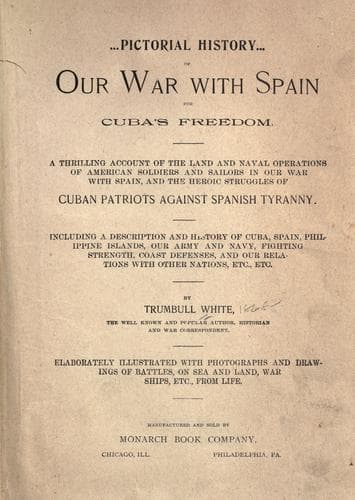
Our War with Spain for Cuba's FreedomWhite, Trumbull
History
Our War with Spain for Cuba's Freedom
White, Trumbull
Cuba -- History; Spain -- Foreign relations -- United States; Spanish-American War, 1898; United States -- Foreign relations -- Spain
The target practice of the flagship was an inspiring sight. At
every shot from her batteries, clouds of dust and big pieces of
stone showed where the Spanish forts were suffering. The New York,
after reducing the range from over six thousand to three thousand
yards, fired shells at the rate of three a minute into the enemy's
forts, each one creating havoc. The Puritan took equally good care
of Point Maya. When she succeeded in getting the range, her
gunners landed a shell inside the works at every shot.
When permission was given to the Cincinnati to take part in the
first battle between Yankee and Spanish forces, the cruiser came
up to within 2,000 yards of the shore, and almost immediately her
guns were at work. Cadet Boone on the flagship fired the first gun
in answer to the Spanish batteries.
The Spanish mail steamer Argonauta, Captain Lage, was convoyed
into Key West harbor by the United States cruiser Marblehead on
May 3. Colonel Vicente De Cortijo of the Third Spanish cavalry,
who, with nineteen other army officers, was taken on the prize, is
a brother-in-law of Lieutenant General Valeriano Weyler. Colonel
De Cortijo and the other officers were transferred to the Guido
and the privates to the Ambrosio Bolivar, two other trophies of
the first week of the war.
The Argonauta herself was no mean prize, being of 1,000 tons
burden, but the value of the capture was mainly in the prisoners
of war and the mail matter going to General Blanco. Her cargo was
general merchandise, with a large quantity of ammunition and
supplies for the Spanish troops in Cuba.
THE SITUATION IN HAVANA.
A correspondent wrote from Havana, on the 3d of May, as follows:
"The dispatch boat succeeded again to-day in opening communication
with Havana, and your correspondent brought away with him the
morning papers of yesterday.
"The City of Havana is a sad sight. There are still a few of the
reconcentrados about the streets now, but starvation has ended the
misery of most of them, and their bones have been thrown into the
trenches outside of the city.
"Starvation now faces the Spanish citizens themselves. Havana is a
graveyard. Two-thirds of the inhabitants have fled. The other
third is beginning to feel the pangs of hunger.
"The prices rival those of Klondike. Beefsteak is $1 a pound.
Chickens are $1 each. Flour is $50 a barrel. Everything is being
confiscated for Blanco's army. Sleek, well-fed persons are daily
threatened with death to make them divulge the whereabouts of
their hidden stores of provisions.
"Several provision stores in the side streets have been broken
into and looted. General Blanco is being strongly urged to sink
artesian wells to provide water in the event of a siege, as a
joint attack by the Cuban and American forces would destroy the
aqueduct. It is not thought that Blanco will attempt this, as he
will not have sufficient time.
Public-domain text, read in full here on John Shaqi.
Reviews
Reviews
No reviews yet
Be the first to share your thoughts on this work.
Elsewhere in the archive
Join the Discussion
Join the discussion
Sign in to leave a comment or review.
Sign InorCreate an account