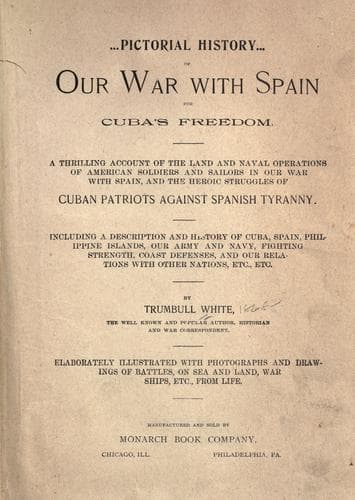
Our War with Spain for Cuba's FreedomWhite, Trumbull
History
Our War with Spain for Cuba's Freedom
White, Trumbull
Cuba -- History; Spain -- Foreign relations -- United States; Spanish-American War, 1898; United States -- Foreign relations -- Spain
Already there was a film of smoke over the land batteries and
along the line of Spanish ships inshore. The roar of their guns
came across the water. Our fleet paid no attention.
The Olympia, in the lead, counted ten Spanish warships, formed in
a semi-circle in front of the rounding peninsula of Cavite, so
that they were both backed and flanked by the land batteries. The
ten vessels which made the fighting line were the flagships Reina
Christina, the Castilla, the Antonio de Ulloa, the Isla de Cuba,
the Isla de Luzon, the El Correo, the Marquis del Duero, the
Velasco, the Gen. Lezo and the Mindanao, the latter being a mail
steamer which the Spaniards had hastily fitted with guns. The
Castilla was moored head and stern, evidently to give the fleet a
fixed spot from which to maneuver, but the other boats were under
steam and prepared to move.
The Olympia opened fire for the American fleet when two miles away
from the enemy. She began blazing away with her four eight-inch
turret guns. The thunders of sound came rolling across the water
and the flagships were almost hidden in smoke. Now our ships
circled to the north and east in the general direction of the city
of Manila. That is, the American fleet circling toward the
northeast and further in toward shore all the time, turned and
came back in a southwesterly direction, passing in parade line
directly in front of the Spanish fleet and batteries, so that the
first general broadside was from the port side, or the left of the
ships as one stands on the stern and faces the bow. The McCulloch
had taken its position so that the fleet, in delivering this first
broadside, passed between it and the enemy. The McCulloch and the
Nanshan and Zafiro played in behind the heavy line like the backs
of a football team.
Having delivered the port broadside, the American fleet turned,
heading toward the shore, and moved back toward the northeast,
delivering the starboard broadside.
As our ships passed to and fro, the stars and stripes could be
seen whirling out from the clouds of smoke, and as the line passed
the second and third times without a sign of any ship being
injured, the sailors began to feel that the Spaniards were not so
formidable after all. Their shots went tearing away over our ships
or splashed the water farther in shore. Some of the men who fought
at the guns said that after the first general broadside, the
sailors laughed at the wild shots, and exposed themselves
recklessly, feeling that they were in no particular danger.
Public-domain text, read in full here on John Shaqi.
Reviews
Reviews
No reviews yet
Be the first to share your thoughts on this work.
Elsewhere in the archive
Join the Discussion
Join the discussion
Sign in to leave a comment or review.
Sign InorCreate an account