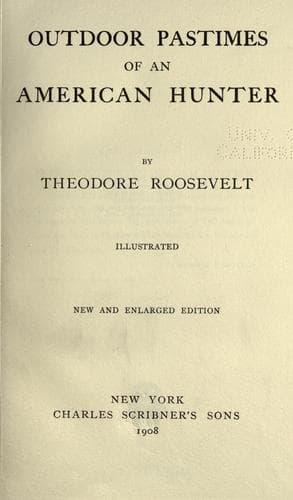
Outdoor pastimes of an American hunterRoosevelt, Theodore
General
Outdoor pastimes of an American hunter
Roosevelt, Theodore
Hunting -- United States; Hunting -- West (U.S.)
One of the antelope I killed while I was out on foot toward nightfall, a
couple of miles from the wagon. I saw the prongbuck quite half a mile
off, and though I dropped at once I was uncertain whether he had seen
me. He was in a little hollow or valley. A long, smoothly sloping
plateau led up to one edge of it. Across this plateau I crawled, and
when I thought I was near the run I ventured slowly to look up, and
almost immediately saw vaguely through the tops of the long grasses what
I took to be the head and horns of the buck, looking in my direction.
There was no use in going back, and I dropped flat on my face again and
crawled another hundred yards, until it was evident that I was on the
rise from which the plateau sank into the shallow valley beyond. Raising
my head inch by inch, I caught sight of the object toward which I had
been crawling, and after a moment’s hesitation recognized it as a dead
sunflower, the stalks and blossoms so arranged as to be in a V shape.
Completely puzzled, I started to sit up, when by sheer good luck I
caught sight of the real prongbuck, still feeding, some three hundred
yards off, and evidently unaware of my presence. It was feeding toward a
slight hill to my left. I crept off until behind this, and then walked
up until I was in line with a big bunch of weeds on its shoulder.
Crawling on all-fours to the weeds, I peeped through and saw the
prongbuck still slowly feeding my way. When he was but seventy yards
off, I sat up and shot him; and trudged back to the wagon, carrying the
saddle and hams.
In packing an antelope or deer behind the saddle, I cut slashes through
the sinews of the legs just above the joints; then I put the buck behind
the saddle, run the picket rope from the horn of the saddle, under the
belly of the horse, through the slashes in the legs on the other side,
bring the end back, swaying well down on it, and fasten it to the horn;
then I repeat the same feat for the other side. Packed in this way, the
carcass always rides steady, and cannot shake loose, no matter what
antics the horse may perform.
In the fall of 1896 I spent a fortnight on the range with the ranch
wagon. I was using for the first time one of the new small calibre,
smokeless-powder rifles, with the usual soft-nosed bullet. While
travelling to and fro across the range we usually moved camp each day,
not putting up the tent at all during the trip; but at one spot we spent
three nights. It was in a creek bottom, bounded on either side by rows
of grassy hills, beyond which stretched the rolling prairie. The creek
bed, which at this season was of course dry in most places, wound in
S-shaped curves, with here and there a pool and here and there a fringe
of stunted wind-beaten timber. We were camped near a little grove of
ash, box-elder, and willow, which gave us shade at noonday; and there
were two or three pools of good water in the creek bed—one so deep that
I made it my swimming-bath.
Public-domain text, read in full here on John Shaqi.
Reviews
Reviews
No reviews yet
Be the first to share your thoughts on this work.
Elsewhere in the archive
Join the Discussion
Join the discussion
Sign in to leave a comment or review.
Sign InorCreate an account