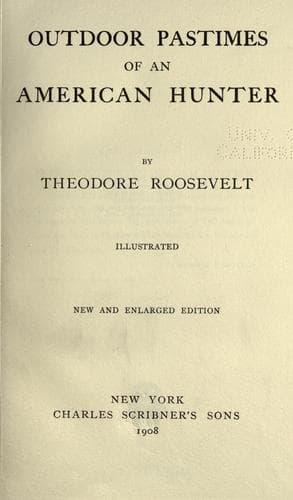
Outdoor pastimes of an American hunterRoosevelt, Theodore
General
Outdoor pastimes of an American hunter
Roosevelt, Theodore
Hunting -- United States; Hunting -- West (U.S.)
band raced away I saw him sink backward, the ball having broken his
hips.
We packed him bodily behind Sylvane on the buckskin and continued our
ride, as there was no fresh meat in camp, and we wished to bring in a
couple of bucks if possible. For two or three hours we saw nothing. The
unshod feet of the horses made hardly any noise on the stretches of
sun-cured grass, but now and then we passed through patches of thin
weeds, their dry stalks rattling curiously, making a sound like that of
a rattlesnake. At last, coming over a gentle rise of ground, we spied
two more prongbucks, half a mile ahead of us and to our right.
Again there seemed small chance of bagging our quarry, but again fortune
favored us. I at once cantered Muley ahead, not toward them, but so as
to pass them well on one side. After some hesitation they started, not
straight away, but at an angle to my own course. For some moments I kept
at a hand gallop, until they got thoroughly settled in their line of
flight; then I touched Muley, and he went as hard as he knew how.
Immediately the two panic-stricken and foolish beasts seemed to feel
that I was cutting off their line of retreat, and raced forward at mad
speed. They went much faster than I did, but I had the shorter course,
and when they crossed me they were not fifty yards ahead—by which time I
had come nearly a mile. At the pull of the rein Muley stopped short,
like the trained cow-pony he is; I leaped off, and held well ahead of
the rearmost and largest buck. At the crack of the little rifle down he
went with his neck broken. In a minute or two he was packed behind me on
Muley, and we bent our steps toward camp.
During the remainder of my trip we were never out of fresh meat, for I
shot three other bucks—one after a smart chase on horseback, and the
other two after careful stalks; and I missed two running shots.
The game being both scarce and shy, I had to exercise much care, and
after sighting a band I would sometimes have to wait and crawl round for
two or three hours before they would get into a position where I had any
chance of approaching. Even then they were more apt to see me and go off
than I was to get near them.
Antelope are the only game that can be hunted as well at noonday as in
the morning or evening, for their times for sleeping and feeding are
irregular. They never seek shelter from the sun, and when they lie down
for a noonday nap they are apt to choose a hollow, so as to be out of
the wind; in consequence, if the band is seen at all at this time, it is
easier to approach them than when they are up and feeding. They
sometimes come down to water in the middle of the day, sometimes in the
morning or evening. On this trip I came across bands feeding and resting
at almost every hour of the day. They seemed usually to rest for a
couple of hours, then began feeding again.
Public-domain text, read in full here on John Shaqi.
Reviews
Reviews
No reviews yet
Be the first to share your thoughts on this work.
Elsewhere in the archive
Join the Discussion
Join the discussion
Sign in to leave a comment or review.
Sign InorCreate an account