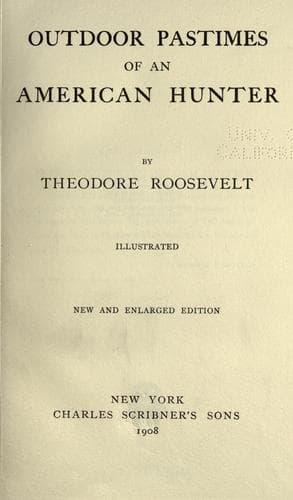
Outdoor pastimes of an American hunterRoosevelt, Theodore
General
Outdoor pastimes of an American hunter
Roosevelt, Theodore
Hunting -- United States; Hunting -- West (U.S.)
There were two stages of hunting in this country, as in almost all other
countries similarly situated. In 1880 the Northern Pacific Railroad was
built nearly to the edge of the Bad Lands, and the danger of Indian war
was totally eliminated. A great inrush of hunters followed. In 1881,
1882 and 1883 buffalo, elk and blacktail were slaughtered in enormous
numbers, and a good many whitetail and prongbuck were killed too. By
1884 the game had been so thinned out that hide-hunting and meat-hunting
ceased to pay. A few professional hunters remained, but most of them
moved elsewhere, or were obliged to go into other business. From that
time the hunting has chiefly been done by ranchers and occasional small
grangers. In consequence, for six or eight years the game about held its
own—the antelope, as I have said above, at one time increasing; but the
gradual growth in the number of actual settlers then began to tell, and
the game became scarce. Nowadays settlers along the Little Missouri can
kill an occasional deer or antelope; but it can hardly be called a game
country.
CHAPTER VI
THE WHITETAIL DEER
The whitetail deer is now, as it always has been, the most plentiful and
most widely distributed of American big game. It holds its own in the
land better than any other species, because it is by choice a dweller in
the thick forests and swamps, the places around which the tide of
civilization flows, leaving them as islets of refuge for the wild
creatures which formerly haunted all the country. The range of the
whitetail is from the Atlantic to the Pacific, and from the Canadian to
the Mexican borders, and somewhat to the north and far to the south of
these limits. The animal shows a wide variability, both individually and
locally, within these confines; from the hunter’s standpoint it is not
necessary to try to determine exactly the weight that attaches to these
local variations.
Public-domain text, read in full here on John Shaqi.
Reviews
Reviews
No reviews yet
Be the first to share your thoughts on this work.
Elsewhere in the archive
Join the Discussion
Join the discussion
Sign in to leave a comment or review.
Sign InorCreate an account