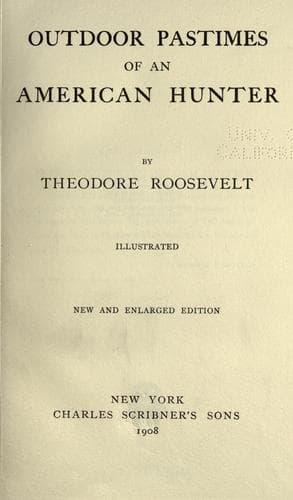
Outdoor pastimes of an American hunterRoosevelt, Theodore
General
Outdoor pastimes of an American hunter
Roosevelt, Theodore
Hunting -- United States; Hunting -- West (U.S.)
In the Adirondacks the deer often completely alter their habits at
different seasons. Soon after the fawns are born they come down to the
water’s edge, preferring the neighborhood of the lakes, but also
haunting the stream banks. The next three months, during the hot
weather, they keep very close to the water, and get a large proportion
of their food by wading in after the lilies and other aquatic plants.
Where they are much hunted, they only come to the water’s edge after
dark, but in regions where they are little disturbed they are quite as
often diurnal in their habits. I have seen dozens feeding in the
neighborhood of a lake, some of them two or three hundred yards out in
shallow places, up to their bellies; and this after sunrise, or two or
three hours before sunset. Before September the deer cease coming to the
water, and go back among the dense forests and on the mountains. There
is no genuine migration, as in the case of the mule-deer, from one big
tract to another, and no entire desertion of any locality. But the food
supply which drew the animals to the water’s edge during the summer
months shows signs of exhaustion toward fall; the delicate water-plants
have vanished, the marsh-grass is dying, and the lilies are less
succulent. An occasional deer still wanders along the shores or out into
the lake, but most of them begin to roam the woods, eating the berries
and the leaves and twig ends of the deciduous trees, and even of some of
the conifers—although a whitetail is fond of grazing, especially upon
the tips of the grass. I have seen moose feeding on the tough old lily
stems and wading after them when the ice had skimmed the edges of the
pool. But the whitetail has usually gone back into the woods long before
freezing-time.
From Long Island south there is not enough snow to make the deer alter
their habits in the winter. As soon as the rut is over, which in
different localities may be from October to December, whitetail are apt
to band together—more apt than at any other season, although even then
they are often found singly or in small parties. While nursing, the does
have been thin, and at the end of the rut the bucks are gaunt, with
their necks swollen and distended. From that time on bucks and does
alike put on flesh very rapidly in preparation for the winter. Where
there is no snow, or not enough to interfere with their travelling, they
continue to roam anywhere through the woods and across the natural
pastures and meadows, eating twigs, buds, nuts, and the natural hay
which is cured on the stalk.
Public-domain text, read in full here on John Shaqi.
Reviews
Reviews
No reviews yet
Be the first to share your thoughts on this work.
Elsewhere in the archive
Join the Discussion
Join the discussion
Sign in to leave a comment or review.
Sign InorCreate an account